Katolsk Horisont
Katolsk internetportal
Search
Search
Hem
Audio
Video
Foto
Predikningar
Bloggar
Sitemap
Predikan 14 augusti 2024, S. Maximilian Maria Kolbe, präst och martyr
Predikan 14 augusti 2024, S. Maximilian Maria Kolbe, präst och martyr
 2 år ago By Göran Fäldt
2024-08-14
Hes 9, 1-7, 10, 18-22; Matt 18, 15-20
Kära medkristna,
När vi idag den 14 augusti i denna församling firar prästen och martyren S:t Maximilian Maria Kolbe som fest är det viktigt att försöka ha ett helhetsperspektiv på hans liv och vad han fortfarande betyder i Kyrkan. I Motala har han fått ett kloster uppkallat efter sig och där firar helgonets ordensbröder också fest till hans minne. Han är skyddshelgon för radioamatörer, knarkare, politiska fångar, familjer och fångar. Det vittnar om det stora inflytandet som lever än idag och vittnar om hans kärlek till Gud. Inte bara Gråbröderna vördar honom som helgon utan hela den katolska världen. Vad var det då som var så märkligt med honom?
Han växte upp i Polen i en katolsk familj med fyra bröder. Två av dem dog unga och Raymond, som han hette som döpt, sörjde mycket. När han var 12 år fick han i en syn se Guds Moder Maria och han frågade henne vad som skulle ske i hans liv. Hon visade honom två kronor, en vit och en röd och frågade vilken han ville ha. Den vita betydde ett liv i renhet och kyskhet och den andra betydde martyrskapet. Raymund svarade att han ville ha båda.
När han senare inträdde i Gråbrödernas orden ville han viga sig till den Obefläckade Avlelsen och leva i lydnad till henne i allt.
Kyrkan hade då 1854 förklarat Marias syndfrihet från födseln som katolsk dogm. Den bekräftades fyra år senare genom Marias arton uppenbarelser i Lourdes till Bernadette Soubirous och i uppenbarelserna i Cova da Iria och i Fatima från den 13 maj till den 13 oktober 1917. Marias budskap var att hennes Obefläckade hjärta skulle segra om bara världen kunde invigas till hennes hjärta och beskydda världen från de onda som skulle komma från Ryssland. Hela Maximilian Marias liv och missionerande arbete skulle präglas av invigningen till Immaculata.
Den andra stora fasen i helgonets liv är martyriet i Auschwitz den 14 augusti 1941, alltså skälet till att festen alltid infaller den dagen. Det är ett så känt ögonblick när Maximilian som katolsk präst erbjuder sig att ta domen och straffet i stället för en medmänniska som var familjefar med hustru i Polen, Franciszek Gajowniczek.
Vid saligförklaringen av Maximilian Maria 1971 av påven Paulus VI förklarades han vara en ”den kristna barmhärtighetens martyr”. Vid kanoniseringen 1982 ville Johannes Paulus II tydliggöra att nazismens gärningar var ett systematiskt hat mot hela mänskligheten och därmed också mot den kristna tron. Påven menade att Maximilians självuppoffring var en gottgörelse för hatet mot religionen och att Maximilian Marias död också var ett martyrium för religionen. Det är i Kyrkan en viktig distinktion. Martyriet är delaktighet i Kristi korslidande.
Den tredje fasen i helgonet liv är miraklerna. Det kan inte råda någon oklarhet att dessa övernaturliga händelser, tillfrisknanden, omvändelser, tacksägelser är Marias verk genom Maximilian Maria Kolbe. En japansk författarinna (Sono Ayako) som försökt förstå hans arbete och betydelse i Japan från 1936 och fram till kriget är övertygad om att Kolbes liv var helt inriktat mot att göra den Obefläckade Avlelsens, Maria Immaculatas önskningar till verklighet.
Intervjuer hon gjort med en präst som arbetat med Kolbe har påverkat henne själv på ett avgörande sätt. Prästen menade att S:t Maximilian Maria ställde sig helt i Marias tjänst. Allt han ville var att underordna sig Maria och vilja göra allt genom henne. Då ger hon också uppgifter att genomföra. Vi är bara hennes små verktyg. Prästen gav den japanska författarinnan rådet att aldrig ställa sig i vägen för den Saliga Jungfrun Maria. ”Det är den högsta kärlek man kan ha för den saliga Guds Moder och därför också för Gud”, sa prästen som känt fader Kolbe.
Kära medkristna, nådens liv i tider av ondska och vantro är kanske det största av alla mirakler. Att kunna se Guds närvaro i plågade och förföljda, hos kränkta och marginaliserade, är vad evangeliet också säger: ”Om din broder har gjort dig någon orätt, så gå och ställ honom till svars i enrum. Lyssnar han på dig har du också vunnit tillbaka din broder” (Matt 18:13).
Om vi jämför en sådan alldaglig gärning med Maximilian Marias barmhärtighetsgärning i koncentrationslägret kanske vi tycker att det är en liten sak. Kanske är det ändå de små tingen, de små gärningarna som är de största. De är sådana gärningar som strömmar ut från Jungfru Marias hjärta, det hjärta som ska segra över allt ont. Amen.
diakon Göran Fäldt
Den Helige Benedictus Kloster
Predikningar
Kortpredikan S. Maximilian Maria Kolbe, präst och martyr
Ingmar Svanteson 14/08
– Jos 3:7-10a,11,13-17 Ps 114:1-6 Matt 18:21-19:1 –
Den 14 augusti 1941 i koncentrationslägret i Auschwitz erbjöd sig Maximilian Kolbe att ta en medfånges plats i dödsbunkern. Medfången hade stor familj.
Hur kunde Maximilian göra detta val? Det fanns inte många sekunders betänketid.
Han praktiserade vad han själv skriver: ”Ibland är livet verkligen svårt och man tror inte att det längre finns någon utväg. Eftersom vi inte kan veta allt, ser vi inte sambandet mellan vår egentliga lycka och de vidriga omständigheter som plågar oss. Vad skall vi alltså göra?” Maximilians svar lyder: ”Lita på Gud”.
Maximilian gjorde det och gav sitt liv för fåren. Den medfånge som befriades var med när Maximilian senare helgonförklarades.
Varje befrielse förebådas när folket går in i det utlovade landet under Josuas ledning.
Vi ser en grandios bild – prästerna, bärande på förbundsarken, står på torr mark mitt i Jordan, medan folket i skydd av arken går in i det utlovade landet – en bild för den öppnade vägen in i Guds rike, Kristi påsk, hans och vårt dop.
Den helige Maximilians självutgivande offer skyddade inte bara familjefadern och hans familj. Alla som ser offret gläder sig och får kraft.
Vi firar det i varje eukaristi. Prästen lyfter upp det nya förbundets tecken och folket går, bildligt talat, torrskodda in i Guds rike.
Detta måste få konsekvenser, inte minst i beredskapen att förlåta.
Oförsonlighet saboterar allt. Viljan att försonas börjar i bönen för ovänner och fiender.
Den eukaristiska bönen fortsätter i Fader vår: ”Förlåt oss våra skulder, såsom ock vi förlåter dem oss skyldiga äro”.
St. Maximilian KolbeCatholic Online
Saints & Angels

Facts
Feastday: August 14
Patron: of drug addicts, prisoners, families, and the pro-life movement
Birth: January 8, 1894
Death: August 14, 1941
Beatified: By Pope Paul VI on October 17, 1971
Canonized: By Pope John Paul II on October 10, 1982
Author and Publisher - Catholic Online
Printable PDF of St. Maximilian Kolbe
Shop St. Maximilian Kolbe
St. Maximilian Kolbe was born as Raymund Kolbe on January 8, 1894, in the Kingdom of Poland, part of the Russian Empire. He was a Polish Conventual Franciscan friar and a martyr in the German death Camp of Auschwitz during World War II.
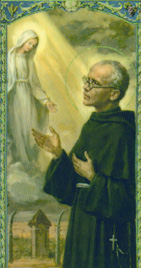
St. Maximilian Kolbe was very active in promoting the Immaculate Virgin Mary and is known as the Apostle of Consecration to Mary. Much of his life was strongly influenced by a vision he had of the Virgin Mary when he was 12.
"That night I asked the Mother of God what was to become of me. Then she came to me holding two crowns, one white, the other red. She asked me if I was willing to accept either of these crowns. The white one meant that I should persevere in purity, and the red that I should become a martyr. I said that I would accept them both."
One year after his vision, Kolbe and his elder brother, Francis joined the Conventual Franciscans. In 1910, Kolbe was given the religious name Maximilian, after being allowed to enter the novitiate, and in 1911, he professed his first vows.
At the age of 21, Kolbe earned a doctorate in philosophy from the Pontifical Gregorian University. He would also earn a doctorate in theology by the time he was 28.
St. Maximilian Kolbe organized the Militia Immaculata (Army of the Immaculate One) after witnessing demonstrations against Pope St. Pius X and Benedict XV. His goal was to work for the conversion of sinners and enemies of the Church, specifically, the Freemasons and he would so with the intercession of Mary.
In 1918, he was ordained a priest and continued his work of promoting Mary throughout Poland. Over the next several years, Kolbe took on publishing. He founded a monthly periodical titled, "Rycerz Niepokalanej" (Knight of the Immaculate). He also operated a religious publishing press and founded a new Conventual Franciscan monastery at Niepokalanow, which became a major religious publishing center.
Kolbe also founded monasteries in both Japan and India. To this day, the monastery in Japan remains prominent in the Roman Catholic Church in Japan.
In 1936, Kolbe's poor health forced him to return home to Poland, and once the WWII invasion by Germany began, he became one of the only brothers to remain in the monastery. He opened up a temporary hospital to aid those in need. When his town was captured, Kolbe was sent to prison but released three months later.
Kolbe refused to sign a document that would recognize him as a German citizen with his German ancestry and continued to work in his monastery, providing shelter for refugees - including hiding 2,000 Jews from German persecution. After receiving permission to continue his religious publishing, Kolbe's monastery acted as a publishing house again and issued many anti-Nazi German publications.
On February 17, 1941, the monastery was shut down; Kolbe was arrested by the German Gestapo and taken to the Pawiak prison. Three months later, he was transferred to Auschwitz.
Never abandoning his priesthood, Kolbe was the victim to severe violence and harassment. Toward the end of his second month in Auschwitz, men were chosen to face death by starvation to warn against escapes. Kolbe was not chosen but volunteered to take the place of a man with a family.
It is said during the last days of his life Kolbe led prayers to Our Lady with the prisoners and remained calm. He was the last of the group to remain alive, after two weeks of dehydration and starvation. The guards gave him a lethal injection of carbolic acid. The stories tell that he raised his left arm and calmly awaited death.
St. Maximilian Kolbe died on August 14 and his remains were cremated on August 15, the same day as the Assumption of Mary feast day.
Recognized as the Servant of God, Kolbe was beatified as a "Confessor of the Faith" on October 17, 1971 by Pope Paul VI and canonized by Pope John Paul II on October 10, 1982. Pope John Paul II declared Kolbe not a confessor, but a martyr.
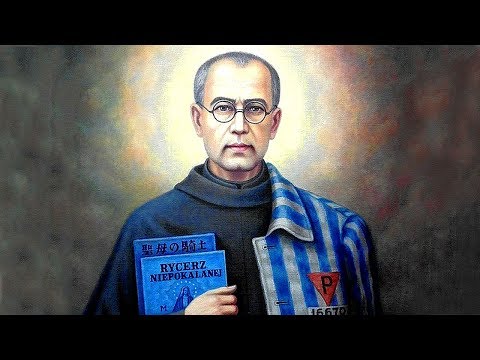
Kolbe's is often depicted in a prison uniform and with a needle being injected into an arm. He is the patron saint of drug addicts, prisoners, families, and the pro-life movement and his feast day is celebrated on August 14.
Additional Content Provided by Wikipedia
Maximilian Maria Kolbe, OFM Conv. (born Raymund Kolbe; Polish: Maksymilian Maria Kolbe;[a] 8 January 1894 – 14 August 1941) was a Polish Conventual Franciscan friar, priest, missionary, and martyr. He volunteered to die in place of a man named Franciszek Gajowniczek in the German death camp of Auschwitz, located in German-occupied Poland during World War II. He had been active in promoting the veneration of the Immaculate Virgin Mary, founding and supervising the monastery of Niepokalanów near Warsaw, operating an amateur-radio station (SP3RN), and founding or running several other organizations and publications.
On 10 October 1982, Pope John Paul II canonized Kolbe and declared him a martyr of charity.[2] The Catholic Church venerates him as the patron saint of amateur radio operators, drug addicts, political prisoners, families, journalists, and prisoners.[1] John Paul II declared him "the patron of our difficult century".[3][4] His feast day is 14 August, the day of his martyrdom. Due to Kolbe's efforts to promote consecration and entrustment to Mary, he is known as an "apostle of consecration to Mary".[5]
Early life
Raymund Kolbe was born on 8 January 1894 in Zduńska Wola, in the Kingdom of Poland, then a puppet state of the Russian Empire. He was the second son of weaver Julius Kolbe and midwife Maria Dąbrowska.[6] His father was an ethnic German,[7] and his mother was Polish. Raymund had four brothers, two of whom died of tuberculosis. Shortly after his birth, his family moved to Pabianice in Poland.[6] In 1903, when he was age nine, Kolbe experienced a vision of the Virgin Mary.[8] He later described this incident:
That night I asked the Mother of God what was to become of me. Then she came to me holding two crowns, one white, the other red. She asked me if I was willing to accept either of these crowns. The white one meant that I should persevere in purity and the red that I should become a martyr. I said that I would accept them both.[9]
Franciscan friar
In 1907, Kolbe and his elder brother Francis joined the Order of Friars Minor Conventual, known as the Conventual Franciscans.[10] They enrolled at the Conventual Franciscan minor seminary in Lwów, in present-day Ukraine, later that year. In 1910, the Franciscans allowed Raymund Kolbe to enter the novitiate, where he chose a religious name, Maximilian. He professed his first vows to the order in 1911, and his final vows in 1914,[11] adopting the additional name of Maria (Mary).[6]
World War I
The Franciscans sent Kolbe to Rome in 1912 to attend the Pontifical Gregorian University. While he was studying at the Gregorian, World War I broke out in 1914. The next year, Kolbe's father, Julius, joined the Polish Legions, a unit in the Austro-Hungarian Army led by Józef Piłsudski. Julius was captured later that year by the Imperial Russian Army and was hanged as a traitor. The news of his father's execution traumatized Kolbe.[12]
Kolbe earned a Doctor of Philosophy from the Gregorian in 1915. Kolbe then continued his studies at the Pontifical University of St. Bonaventure in Rome, where he earned a doctorate in theology in either 1919[6] or 1922.[13] During this period, he became active in the consecration and entrustment to Mary. While in Rome, Kolbe witnessed vehement demonstrations by Freemasons against Pope Pius X and later Pope Benedict XV. According to Kolbe:
They placed the black standard of the "Giordano Brunisti" under the windows of the Vatican. On this standard the archangel, Michael, was depicted lying under the feet of the triumphant Lucifer. At the same time, countless pamphlets were distributed to the people in which the Holy Father (i.e., the Pope) was attacked shamefully.[14][15]
To counter these demonstrations, Kolbe started the Militia Immaculatae (Army of the Immaculate One) on 16 October 1917. This was a group of Catholics who prayed for the conversion of sinners and enemies of the Catholic Church, specifically the Freemasons, through the intercession of the Virgin Mary.[16][13] So serious was Kolbe about this goal that he added a line to the Miraculous Medal prayer:
O Mary, conceived without sin, pray for us who have recourse to thee. And for all those who do not have recourse to thee; especially the Freemasons and all those recommended to thee.[17]
During this period, Kolbe proposed that the entire Franciscan Order be consecrated to the Immaculate by an additional vow. The idea was well received, but faced the hurdles of approval by the hierarchy of the order and the lawyers and was never adopted.[18]
Priesthood
In 1918, Kolbe was ordained a priest.[19] In July 1919, after the end of World War I, he returned to Poland to teach at the Kraków Seminary. The Second Polish Republic had won its independence from the Russian Republic in 1918. While in Kraków, Kolbe was active in promoting the veneration of the Immaculate Virgin Mary. He was strongly opposed to socialist and communist movements that had surfaced in Poland after the war.[6]
In 1922, a recurrence of tuberculosis forced Kolbe to leave the seminary.[6][13][19] In January 1922, Kolbe founded the monthly periodical Rycerz Niepokalanej (Knight of the Immaculata), a devotional publication based on the French Le Messager du Coeur de Jesus (Messenger of the Heart of Jesus). From 1922 to 1926, he operated a religious publishing press in Grodno in present-day Belarus.[6] As his activities grew in scope, in 1927 he founded a new Conventual Franciscan monastery at Niepokalanów near Warsaw. It became a major religious publishing centre.[13][6][19] A junior seminary was opened there two years later.[13]
Missionary work in Asia
During the 1920s, Kolbe encountered a group of Japanese Catholics studying in Poland. They lamented the lack of Catholic missionaries in Japan, prompting Kolbe to consider making a missionary trip to East Asia.[20][6][19] Kolbe arrived in 1930 in Shanghai, then part of the Republic of China. However, his mission failed to gather a following there, prompting him to move to Japan.[6] Kolbe soon acquired a basic literacy in Japanese.[21] In 1931, Kolbe founded a Franciscan monastery, Mugenzai no Sono (無原罪の園, transl. Garden of the Immaculata),[b] outside Nagasaki.[21] The monastery soon began publishing a Japanese edition of the Knight of the Immaculata.[20][6][19] In mid-1932, Kolbe left Japan for Malabar, then part of British India, where he founded another monastery.[13][self-published source]
Return to Poland
Meanwhile, in his absence the monastery at Niepokalanów began to publish a daily newspaper Mały Dziennik (the Small Diary), in alliance with the political group National Radical Camp (Obóz Narodowo Radykalny).[13][6] This publication reached a circulation of 137,000, and nearly double that, 225,000, on weekends.[22] Kolbe returned to Poland in 1933 for a general chapter of the order in Kraków.[23][24] Kolbe returned to Japan and remained there until called back to attend the Provincial Chapter in Poland in 1936. There he was appointed guardian of Niepokalanów, thus precluding his return to Japan. In 1938, he started a radio station at Niepokalanów, Radio Niepokalanów.[13][self-published source][25] He held an amateur radio license, with the call sign SP3RN.[26]
World War II
The invasion of Poland on 1 September 1939 by the German Army signaled the start of World War II. Kolbe was one of the few priests who remained in the monastery, where he organized a temporary hospital.[6] After the Germans captured Niepokalanów, they arrested Kolbe on 19 September 1939.[13][6] While in custody, Kolbe refused to sign the Deutsche Volksliste (German People's List). Doing so would have given him rights similar to those of German citizens in exchange for recognizing his ethnic German ancestry.[27] The Germans released him on 8 December 1939.[13]
Upon his release, he continued work at his friary where he and other friars provided shelter to refugees from Greater Poland, including 2,000 Jews whom he hid from Nazi persecution in the Niepokalanów friary.[13][self-published source][19][28][27][29] Kolbe received permission to continue publishing religious works, though significantly reduced in scope.[27] The monastery continued to act as a publishing house, issuing a number of publications considered anti-Nazi.[13][self-published source][19]
Imprisonment and death
 Maximilian Kolbe's prison cell in Block 11, Auschwitz concentration camp
On 17 February 1941, the Gestapo shut down the monastery and arrested Kolbe along with four others. He was incarcerated in the Pawiak prison in Warsaw.[13] On 28 May 1941, the Germans transferred Kolbe to the Auschwitz concentration camp as prisoner 16670.[30]
 Kolbe, on a West German postage stamp, marked Auschwitz
Arriving at Auschwitz, Kolbe started ministering to his fellow prisoners. He was subjected to violent harassment by the guards, including beatings and lashings. On one occasion, sympathetic inmates smuggled the wounded Kolbe to a prisoner hospital.[13][27] At the end of July 1941, a prisoner successfully escaped from Auschwitz. In reprisal, the deputy camp commander, SS-Hauptsturmführer Karl Fritzsch, ordered guards to pick ten men to be starved to death in an underground bunker. When selected, Franciszek Gajowniczek, a Polish Catholic, cried out, "My wife! My children!" At that moment, Kolbe volunteered to take his place.[10]
An assistant janitor later testified that Kolbe led the prisoners in prayer from his prison cell. Each time the guards checked on him, he was standing or kneeling in the middle of the cell, calmly looking at those who entered. After the group had been starved and deprived of water for two weeks, only Kolbe and three others remained alive.[31] Impatient to empty the bunker, the guards gave the four remaining prisoners lethal injections of carbolic acid. Kolbe is said to have raised his left arm and calmly waited for it.[19] Maximilian Kolbe died on 14 August 1941. He was cremated on 15 August, which happened to be the feast day of the Assumption of Mary.[27]
Canonization
The cause for Kolbe's beatification was opened at a local level on 3 June 1952.[32] On 12 May 1955, Kolbe was recognized by Pope Pius XII as a servant of God.[27] Kolbe was declared venerable by Pope Paul VI on 30 January 1969 and beatified as a confessor of the faith by the same pope in 1971. The miracles used to confirm Kolbe's beatification were the July 1948 cure of intestinal tuberculosis in Angela Testoni and the August 1950 cure of calcification of the arterial sclerosis of Francis Ranier. Both individuals attributed their cures to Kolbe's intercession by their prayers to him.[13][self-published source]
Kolbe was canonized by Pope John Paul II on 10 October 1982.[13][33] The pope declared him as a confessor and a martyr of charity. Franciszek Gajowniczek, the man Kolbe saved at Auschwitz, survived the Holocaust and was present as a guest at both the beatification and the canonization ceremonies.[34]
 The statue of Kolbe (left) above the Great West Door of Westminster Abbey
The feast of Saint Maximilian Kolbe was added to the General Roman Calendar. He is one of 10 20th-century martyrs depicted in statues above the Great West Door of the Anglican Westminster Abbey in London.[35] Kolbe is remembered in the Calendar of saints of the Church of England with a commemoration on 14 August.[36]
Controversies
Kolbe's recognition as a martyr generated some controversy within the Catholic Church.[37] While his self-sacrifice at Auschwitz was considered saintly and heroic, he was not killed as a result of odium fidei ("hatred of the faith"), but as the result of his act of charity toward another man. Pope Paul VI recognized this distinction at Kolbe's beatification, naming him a confessor and a "martyr of charity". John Paul II, however, overruled the commission he had established (which agreed with the earlier assessment of heroic charity). John Paul II wanted to make the point that the Nazis' systematic hatred of whole categories of humanity was inherently also a hatred of religious (Christian) faith; he said that Kolbe's death equated to earlier examples of religious martyrdom.[37]
Accusations of antisemitism
Kolbe's alleged antisemitism was a source of controversy in the 1980s in the aftermath of his canonization.[38] In 1926, in the first issue of the monthly Knight of the Immaculate, Kolbe said he considered Freemasons "as an organized clique of fanatical Jews, who want to destroy the church."[39] In a 1924 column, he cited the Protocols of the Elders of Zion as an "important proof" that "the founders of Zionism intended, in fact, the subjugation of the entire world", but that "not even all Jews know this".[40] In a calendar that the publishing house of his organization, the Militia of the Immaculate, published in an edition of a million in 1939, Kolbe wrote,
Atheistic Communism seems to rage ever more wildly. Its origin can easily be located in that criminal mafia that calls itself Freemasonry, and the hand that is guiding all that toward a clear goal is international Zionism. Which should not be taken to mean that even among Jews one cannot find good people.[41]
In his periodicals, Kolbe published articles about topics such as a Zionist plot for world domination.[42][43][44] Slovenian philosopher Slavoj Žižek criticized Kolbe's activities as "writing and organizing mass propaganda for the Catholic Church, with a clear anti-Semitic and anti-Masonic edge."[43][45] In contrast, a writer for online EWTN stated that the "Jewish question played a very minor role in Kolbe's thought and work" and that "only thirty-one out of over 14,000 of his letters reference the Jewish people or Judaism, and most express a missionary zeal and concern for their spiritual welfare".[46]
According to the anti-racist "Never Again" Association[47]
In 1938, in ‘Maly Dziennik’, Kolbe argued, ‘Jewry has harmed and continues to harm us all the time, it is eating into the body of the nation like a cancer.
During World War II, Kolbe's monastery at Niepokalanów sheltered Jewish refugees.[43] According to the testimony of a local, "When Jews came to me asking for a piece of bread, I asked Father Maximilian if I could give it to them in good conscience, and he answered me, 'Yes, it is necessary to do this because all men are our brothers.'"[46]
Relics
First-class relics of Kolbe exist, in the form of hairs from his head and beard, preserved without his knowledge by two friars at Niepokalanów who served as barbers in his friary between 1930 and 1941. Since his beatification in 1971, more than 1,000 such relics have been distributed around the world for public veneration.[48] Second-class relics, such as his personal effects, clothing and liturgical vestments, are preserved in his monastery cell and in a chapel at Niepokalanów, where they may be venerated by visitors.[48]
Influence
 The first monument to Maximilian Kolbe in Poland in Chrzanów
Kolbe influenced his own Order of Conventual Franciscan friars, as the Militia Immaculatae movement had continued.[49] In recent years, new religious and secular institutes have been founded, inspired by this spiritual way. Among these are the Missionaries of the Immaculate Mary – Fr. Kolbe, the Franciscan Friars of Mary Immaculate, and a parallel congregation of religious sisters and others. The Franciscan Friars of Mary Immaculate are taught basic Polish so they can sing the traditional hymns Kolbe sang in his native tongue.[50] According to the friars:
Our patron, St. Maximilian Kolbe, inspires us with his unique Mariology and apostolic mission, which is to bring all souls to the Sacred Heart of Christ through the Immaculate Heart of Mary, Christ's most pure, efficient, and holy instrument of evangelization – especially those most estranged from the Church.[50]
 Stained-glass window by Alois Plum depicting Edith Stein and Maximilian Kolbe
Kolbe's views into Marian theology echo today through their influence on Vatican II.[13] His image may be found in churches across Europe[35] and throughout the world. Several churches in Poland are under his patronage, such as the Sanctuary of Saint Maxymilian in Zduńska Wola and the Church of Saint Maxymilian Kolbe in Szczecin.[51][52] A museum, Museum of St. Maximilian Kolbe "There was a Man", was opened in Niepokalanów in 1998.[53]
In 1963, Rolf Hochhuth published The Deputy, a play influenced by Kolbe's life, and dedicated to him.[27] In 2000, the National Conference of Catholic Bishops (US) designated Marytown in Libertyville, Illinois home to a community of Conventual Franciscan friars, as the National Shrine of St. Maximilian Kolbe.[54] In 1991, Krzysztof Zanussi released a biographical Polish film about Kolbe, Life for Life: Maximilian Kolbe [pl], with Edward Żentara as Kolbe. The Polish Senate declared 2011 to be the year of Kolbe.[55]
 Bust of Kolbe in Henryk Jordan Park in Kraków
In 2023, the Mexican production company Dos Corazones Films released the animated feature film Max, which recounts part of Kolbe's life.[56] The 2025 film Triumph of the Heart tells the story of Kolbe's final weeks in the Block 11 starvation chamber. The film was written and directed by Anthony D'Ambrosio and stars Marcin Kwasny.[57]
Immaculata prayer
Kolbe composed the Immaculata prayer as a prayer of consecration to the Immaculata.[
Ingmar Svanteson
Lördag den 15 augusti
JUNGFRU MARIAS UPPTAGNING TILL HIMLEN
Högtid
Mässan på dagen
Första läsningen Upp 11:19a; 12:1–6a, 10ab
Guds tempel i himlen öppnades, och förbundsarken blev synlig i hans tempel. Och ett stort tecken syntes på himlen, en kvinna klädd i solen och med månen under sina fötter och en krans av tolv stjärnor på sitt huvud. Hon är havande och hon ropar i barnsnöd och födslovånda.
Och ett annat tecken syntes på himlen, och se, en stor eldröd drake, med sju huvuden och tio horn och med sju kronor på sina huvuden. Hans stjärt svepte med sig en tredjedel av stjärnorna på himlen och slungade dem ner på jorden. Och draken stod framför kvinnan som skulle föda, för att sluka hennes barn när hon födde det. Och hon födde sitt barn, en son som skall valla alla folk med en stav av järn. Hennes barn rycktes upp till Gud och hans tron, och kvinnan flydde ut i öknen, där Gud har berett henne en tillflykt. Och jag hörde en stark röst i himlen säga: »Nu finns frälsningen och kraften och riket hos vår Gud och makten hos hans smorde.«
Responsoriepsalm Ps 45:10b–12b, 15–16 (R. jfr 10b)
R. Drottningen står vid din högra sida i gyllene skrud.
En drottning står vid din högra sida i guld från Ofír.
Hör, dotter, och ge akt, och vänd hit ditt öra :
Glöm nu ditt folk och din faders hus,
så att konungen får ha sin lust i din skönhet −
han är din herre, och för honom skall du falla ned. R.
I brokigt vävda kläder förs hon till konungen,
jungfrur, hennes väninnor, följer henne,
de leds in till dig.
Under glädje och fröjd förs de fram,
de tågar in i konungens palats. R
Andra läsningen 1 Kor 15:20–27a
Kristus har uppstått från de döda, som den förste av de avlidna. Ty eftersom döden kom genom en människa kommer också uppståndelsen från de döda genom en människa. Liksom alla dör genom Adam, så skall också alla få nytt liv genom Kristus. Men i tur och ordning: först Kristus och därefter, vid hans ankomst, de som tillhör honom. Sedan kommer slutet, när han överlämnar riket åt Gud, fadern. Då har han förintat varje välde och varje makt och kraft, ty han måste härska tills han har lagt alla fiender under sina fötter. Den siste fienden som förintas är döden, ty allt har han lagt under sina fötter.
Halleluja
V. Änglaskaran gläder sig och jublar,
ty Maria är upptagen i himmelen.
Evangelium Luk 1:39–56
Vid den tiden gav sig Maria i väg och skyndade till en stad i Juda bergsbygd; hon gick till Sakarias hus och sökte upp Elisabet. När Elisabet hörde Marias hälsning, sparkade barnet till i henne, och hon fylldes av helig ande. Hon ropade med hög röst: »Välsignad är du mer än andra kvinnor, och välsignat det barn du bär inom dig. Hur kan det hända mig, att min herres mor kommer till mig? När mina öron hörde din hälsning, sparkade barnet till i mig av fröjd. Salig hon som trodde, ty det som Herren har låtit säga henne skall gå i uppfyllelse.« Då sade Maria:
»Min själ prisar Herrens storhet,
min ande jublar över Gud, min frälsare:
han har vänt sin blick
till sin ringa tjänarinna.
Från denna stund skall alla släkten prisa mig salig:
stora ting låter den Mäktige ske med mig,
hans namn är heligt,
och hans förbarmande med dem
som fruktar honom
varar från släkte till släkte.
Han gör mäktiga verk med sin arm,
han skingrar dem som har övermodiga planer.
Han störtar härskare från deras troner,
och han upphöjer de ringa.
Hungriga mättar han med sina gåvor,
och rika skickar han tomhänta bort.
Han tar sig an sin tjänare Israel
och håller sitt löfte till våra fäder:
att förbarma sig över Abraham
och hans barn, till evig tid.«
Maria stannade hos henne omkring tre månader och återvände sedan hem.
Post
See new posts
Conversation
EWTN Global Catholic Network
@EWTN
The power of trusting in God's providence
 Saint Maximilian Kolbe and Mother Angelica had this in common. Mother Angelica can barely contain her excitement regarding the miracles and holy places of Saint Maximilian Kolbe and Poland. Originally aired September 26, 1984
https://x.com/EWTN/status/2088052987507753426?s=20
Saint Maximilian Kobe's seven key ways to holiness; 1.Consecrate Yourself to the Immaculate Virgin Mary: Kolbe taught that total consecration to Mary is the quickest and surest path to holiness. By entrusting all thoughts, actions, and sufferings to her, you allow her to form you in the likeness of Jesus, the model of holiness. This surrender ensures your will aligns with God’s, fostering spiritual growth through her maternal guidance. 2. Strive to Become a Saint: Kolbe’s first rule was, “I must become a saint, and a great saint.” He viewed holiness as a non-negotiable duty, not an optional pursuit. This mindset requires prioritizing sanctity above all else, recognizing that your eternal state depends on your holiness at the moment of death. 3.Align Your Will with God’s Will: Holiness, as Kolbe expressed through his equation “V + v = S” (God’s will + human will = sanctity), comes from uniting your free will with God’s. Obedience to God’s will, discerned through prayer and the guidance of Mary, is essential for spiritual progress. Disobedience or prioritizing personal desires leads to sin. 4. Avoid Sin, Especially Deliberate Venial Sin: Kolbe emphasized fleeing not only mortal sin but also deliberate venial sins, as they obstruct holiness. Repent sincerely after falls, purify your soul through the Sacrament of Penance, and rely on God’s grace to persevere. 5. Live with Intention and Duty: Kolbe’s rules stress performing daily duties faithfully, as holiness lies not in extraordinary deeds but in fulfilling obligations toward God, self, and others with love and intention. He advised living each day as if it were your last, mindful that every action is recorded for eternity. 6. Practice Prayer, Penance, and Perseverance: True holiness, according to Kolbe, is cultivated through consistent prayer, acts of penance, and steadfast perseverance despite setbacks. He encouraged frequent prayer to Mary and reliance on her to sustain resolve, especially in adversity. 7. Embrace the Cross with Sacrificial Love: Kolbe’s life, culminating in his martyrdom at Auschwitz, exemplified embracing suffering for love of God and others. He taught that saints see the Cross as an opportunity for sacrificial love, not a burden, trusting in God’s grace to transform adversity into holiness.
St. Maximilian Kolbe martyr of charity, prisoner number 16670, offered himself in the place of Franciszek Gajowniczek, who was married with a child. “I am a Polish Catholic priest. I want to die in place of this man.” Rare footage of St. Maximilian Kolbe at Auschwitz, one of the most brutal Nazi concentration camps. St. Maximilian Kolbe, OPN
 https://x.com/GrainneMcD92925/status/2088017477884117303?s=20
Döden är en del av livet. Från det ögonblick vi föds dör vi, inte ensamma. Biologiskt. Det finns till och med människor som borde "dö" oftare. Att dö till det förflutna, till agg, hämnd, förolämpningar. Fast i minnet kan de inte förlåta och fokusera på ett annat livsprojekt.
https://x.com/andribaezg/status/2088236716318396489?s=20


Kommentarer
Skicka en kommentar