 |    |  |
 |
|
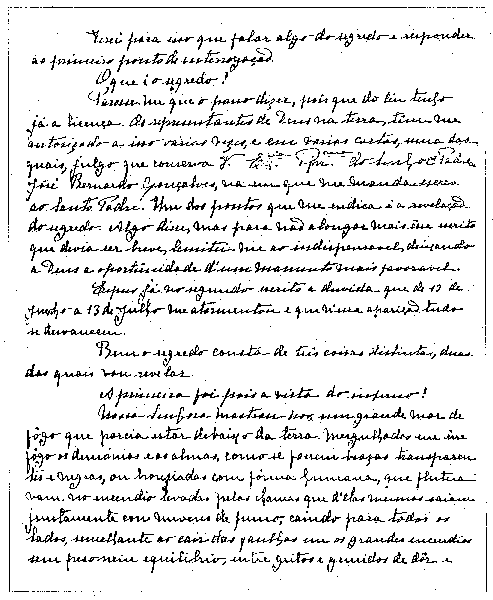
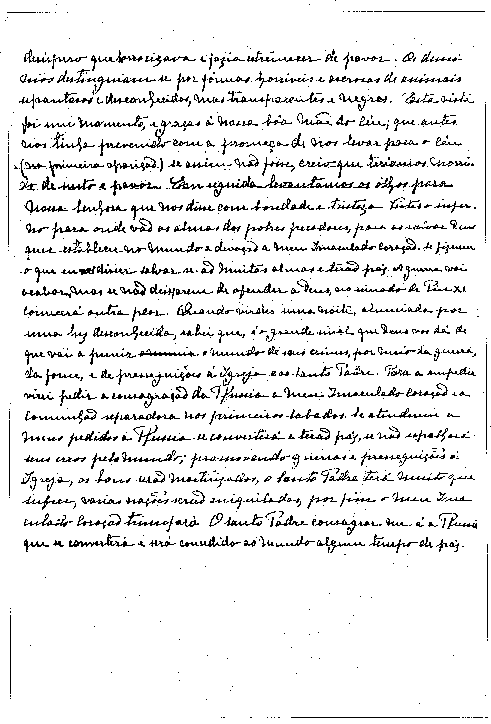
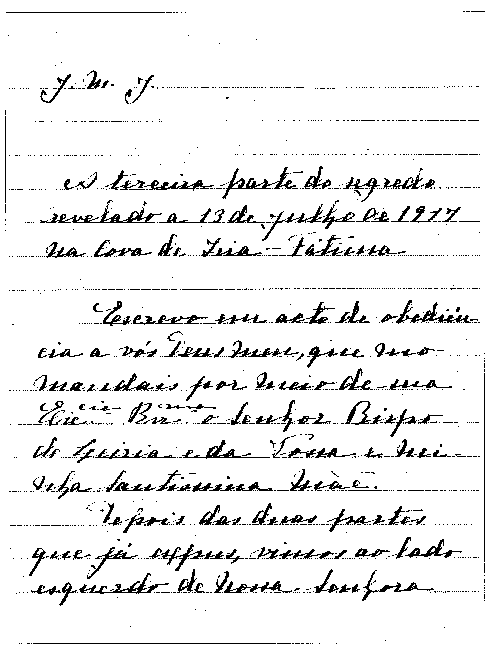
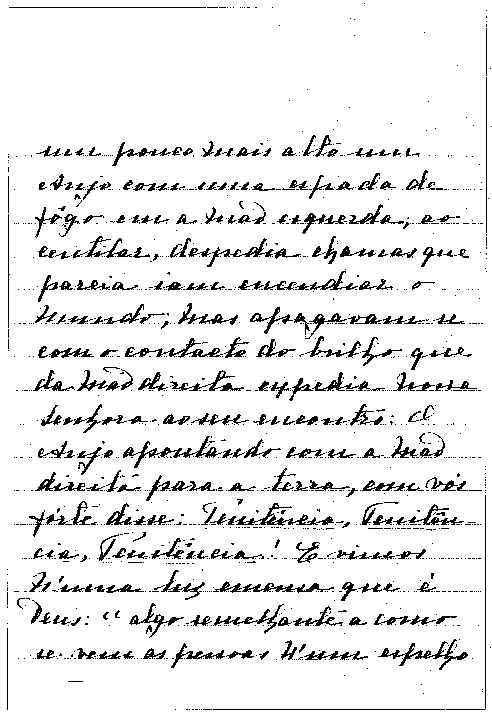
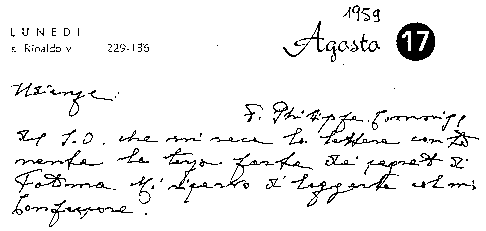
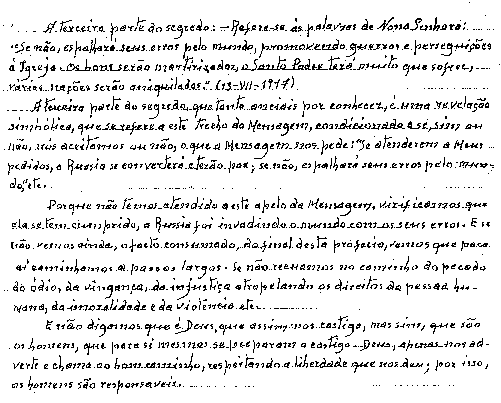
CONGREGATION THE MESSAGE INTRODUCTION As the second millennium gives way to the third, Pope John Paul II has decided to publish the text of the third part of the secret of Fatima. The twentieth century was one of the most crucial in human history, with its tragic and cruel events culminating in the assassination attempt on the sweet Christ on earth. Now a veil is drawn back on a series of events which make history and interpret it in depth, in a spiritual perspective alien to present-day attitudes, often tainted with rationalism. Throughout history there have been supernatural apparitions and signs which go to the heart of human events and which, to the surprise of believers and non-believers alike, play their part in the unfolding of history. These manifestations can never contradict the content of faith, and must therefore have their focus in the core of Christ's proclamation: the Father's love which leads men and women to conversion and bestows the grace required to abandon oneself to him with filial devotion. This too is the message of Fatima which, with its urgent call to conversion and penance, draws us to the heart of the Gospel. Fatima is undoubtedly the most prophetic of modern apparitions. The first and second parts of the secret - which are here published in sequence so as to complete the documentation - refer especially to the frightening vision of hell, devotion to the Immaculate Heart of Mary, the Second World War, and finally the prediction of the immense damage that Russia would do to humanity by abandoning the Christian faith and embracing Communist totalitarianism. In 1917 no one could have imagined all this: the three pastorinhos of Fatima see, listen and remember, and Lucia, the surviving witness, commits it all to paper when ordered to do so by the Bishop of Leiria and with Our Lady's permission. For the account of the first two parts of the secret, which have already been published and are therefore known, we have chosen the text written by Sister Lucia in the Third Memoir of 31 August 1941; some annotations were added in the Fourth Memoir of 8 December 1941. The third part of the «secret» was written «by order of His Excellency the Bishop of Leiria and the Most Holy Mother ...» on 3 January 1944. There is only one manuscript, which is here reproduced photostatically. The sealed envelope was initially in the custody of the Bishop of Leiria. To ensure better protection for the «secret» the envelope was placed in the Secret Archives of the Holy Office on 4 April 1957. The Bishop of Leiria informed Sister Lucia of this. According to the records of the Archives, the Commissary of the Holy Office, Father Pierre Paul Philippe, OP, with the agreement of Cardinal Alfredo Ottaviani, brought the envelopecontaining the third part of the «secret of Fatima» to Pope John XXIII on 17 August 1959. «After some hesitation», His Holiness said: «We shall wait. I shall pray. I shall let you know what I decide».(1) In fact Pope John XXIII decided to return the sealed envelope to the Holy Office and not to reveal the third part of the «secret». Paul VI read the contents with the Substitute, Archbishop Angelo Dell'Acqua, on 27 March 1965, and returned the envelope to the Archives of the Holy Office, deciding not to publish the text. John Paul II, for his part, asked for the envelope containing the third part of the «secret» following the assassination attempt on 13 May 1981. On 18 July 1981 Cardinal Franjo Å eper, Prefect of the Congregation, gave two envelopes to Archbishop Eduardo MartÃnez Somalo, Substitute of the Secretariat of State: one white envelope, containing Sister Lucia's original text in Portuguese; the other orange, with the Italian translation of the «secret». On the following 11 August, Archbishop MartÃnez returned the two envelopes to the Archives of the Holy Office.(2) As is well known, Pope John Paul II immediately thought of consecrating the world to the Immaculate Heart of Mary and he himself composed a prayer for what he called an «Act of Entrustment», which was to be celebrated in the Basilica of Saint Mary Major on 7 June 1981, the Solemnity of Pentecost, the day chosen to commemorate the 1600th anniversary of the First Council of Constantinople and the 1550th anniversary of the Council of Ephesus. Since the Pope was unable to be present, his recorded Address was broadcast. The following is the part which refers specifically to the Act of Entrustment: «Mother of all individuals and peoples, you know all their sufferings and hopes. In your motherly heart you feel all the struggles between good and evil, between light and darkness, that convulse the world: accept the plea which we make in the Holy Spirit directly to your heart, and embrace with the love of the Mother and Handmaid of the Lord those who most await this embrace, and also those whose act of entrustment you too await in a particular way. Take under your motherly protection the whole human family, which with affectionate love we entrust to you, O Mother. May there dawn for everyone the time of peace and freedom, the time of truth, of justice and of hope».(3) In order to respond more fully to the requests of «Our Lady», the Holy Father desired to make more explicit during the Holy Year of the Redemption the Act of Entrustment of 7 May 1981, which had been repeated in Fatima on 13 May 1982. On 25 March 1984 in Saint Peter's Square, while recalling the fiat uttered by Mary at the Annunciation, the Holy Father, in spiritual union with the Bishops of the world, who had been «convoked» beforehand, entrusted all men and women and all peoples to the Immaculate Heart of Mary, in terms which recalled the heartfelt words spoken in 1981: «O Mother of all men and women, and of all peoples, you who know all their sufferings and their hopes, you who have a mother's awareness of all the struggles between good and evil, between light and darkness, which afflict the modern world, accept the cry which we, moved by the Holy Spirit, address directly to your Heart. Embrace with the love of the Mother and Handmaid of the Lord, this human world of ours, which we entrust and consecrate to you, for we are full of concern for the earthly and eternal destiny of individuals and peoples. In a special way we entrust and consecrate to you those individuals and nations which particularly need to be thus entrusted and consecrated. «'We have recourse to your protection, holy Mother of God!' Despise not our petitions in our necessities». The Pope then continued more forcefully and with more specific references, as though commenting on the Message of Fatima in its sorrowful fulfilment: «Behold, as we stand before you, Mother of Christ, before your Immaculate Heart, we desire, together with the whole Church, to unite ourselves with the consecration which, for love of us, your Son made of himself to the Father: 'For their sake', he said, »'I consecrate myself that they also may be consecrated in the truth' (Jn 17:19). We wish to unite ourselves with our Redeemer in this his consecration for the world and for the human race, which, in his divine Heart, has the power to obtain pardon and to secure reparation. The power of this consecrationlasts for all time and embraces all individuals, peoples and nations. It overcomes every evil that the spirit of darkness is able to awaken, and has in fact awakened in our times, in the heart of man and in his history. How deeply we feel the need for the consecration of humanity and the world - our modern world - in union with Christ himself! For the redeeming work of Christ must be shared in by the world through the Church. The present Year of the Redemption shows this: the special Jubilee of the whole Church. Above all creatures, may you be blessed, you, the Handmaid of the Lord, who in the fullest way obeyed the divine call! Hail to you, who are wholly united to the redeeming consecration of your Son! Mother of the Church! Enlighten the People of God along the paths of faith, hope, and love! Enlighten especially the peoples whose consecration and entrustment by us you are awaiting. Help us to live in the truth of the consecration of Christ for the entire human family of the modern world. In entrusting to you, O Mother, the world, all individuals and peoples, we also entrust to you this very consecration of the world, placing it in your motherly Heart. Immaculate Heart! Help us to conquer the menace of evil, which so easily takes root in the hearts of the people of today, and whose immeasurable effects already weigh down upon our modern world and seem to block the paths towards the future! From famine and war, deliver us. From nuclear war, from incalculable self-destruction, from every kind of war, deliver us. From sins against the life of man from its very beginning, deliver us. From hatred and from the demeaning of the dignity of the children of God, deliver us. From every kind of injustice in the life of society, both national and international, deliver us. From readiness to trample on the commandments of God, deliver us. From attempts to stifle in human hearts the very truth of God, deliver us. From the loss of awareness of good and evil, deliver us. From sins against the Holy Spirit, deliver us, deliver us. Accept, O Mother of Christ, this cry laden with the sufferings of all individual human beings, laden with the sufferings of whole societies. Help us with the power of the Holy Spirit to conquer all sin: individual sin and the 'sin of the world', sin in all its manifestations. Let there be revealed, once more, in the history of the world the infinite saving power of the Redemption: the power of merciful Love! May it put a stop to evil! May it transform consciences! May your Immaculate Heart reveal for all the light of Hope!».(4) Sister Lucia personally confirmed that this solemn and universal act of consecration corresponded to what Our Lady wished («Sim, està feita, tal como Nossa Senhora a pediu, desde o dia 25 de Março de 1984»: «Yes it has been done just as Our Lady asked, on 25 March 1984»: Letter of 8 November 1989). Hence any further discussion or request is without basis. In the documentation presented here four other texts have been added to the manuscripts of Sister Lucia: 1) the Holy Father's letter of 19 April 2000 to Sister Lucia; 2) an account of the conversation of 27 April 2000 with Sister Lucia; 3) the statement which the Holy Father appointed Cardinal Angelo Sodano, Secretary of State, to read on 13 May 2000; 4) the theological commentary by Cardinal Joseph Ratzinger, Prefect of the Congregation for the Doctrine of the Faith. Sister Lucia had already given an indication for interpreting the third part of the «secret» in a letter to the Holy Father, dated 12 May 1982: «The third part of the secret refers to Our Lady's words: 'If not [Russia] will spread her errors throughout the world, causing wars and persecutions of the Church. The good will be martyred; the Holy Father will have much to suffer; various nations will be annihilated' (13-VII-1917). The third part of the secret is a symbolic revelation, referring to this part of the Message, conditioned by whether we accept or not what the Message itself asks of us: 'If my requests are heeded, Russia will be converted, and there will be peace; if not, she will spread her errors throughout the world, etc.'. Since we did not heed this appeal of the Message, we see that it has been fulfilled, Russia has invaded the world with her errors. And if we have not yet seen the complete fulfilment of the final part of this prophecy, we are going towards it little by little with great strides. If we do not reject the path of sin, hatred, revenge, injustice, violations of the rights of the human person, immorality and violence, etc. And let us not say that it is God who is punishing us in this way; on the contrary it is people themselves who are preparing their own punishment. In his kindness God warns us and calls us to the right path, while respecting the freedom he has given us; hence people are responsible».(5) The decision of His Holiness Pope John Paul II to make public the third part of the «secret» of Fatima brings to an end a period of history marked by tragic human lust for power and evil, yet pervaded by the merciful love of God and the watchful care of the Mother of Jesus and of the Church. The action of God, the Lord of history, and the co-responsibility of man in the drama of his creative freedom, are the two pillars upon which human history is built. Our Lady, who appeared at Fatima, recalls these forgotten values. She reminds us that man's future is in God, and that we are active and responsible partners in creating that future. Tarcisio Bertone, SDB
THE «SECRET» OF FATIMA FIRST AND SECOND PART OF THE «SECRET» ACCORDING TO THE VERSION PRESENTED BY SISTER LUCIA (original text)
(translation) (6) ... This will entail my speaking about the secret, and thus answering the first question. What is the secret? It seems to me that I can reveal it, since I already have permission from Heaven to do so. God's representatives on earth have authorized me to do this several times and in various letters, one of which, I believe, is in your keeping. This letter is from Father José Bernardo Gonçalves, and in it he advises me to write to the Holy Father, suggesting, among other things, that I should reveal the secret. I did say something about it. But in order not to make my letter too long, since I was told to keep it short, I confined myself to the essentials, leaving it to God to provide another more favourable opportunity. In my second account I have already described in detail the doubt which tormented me from 13 June until 13 July, and how it disappeared completely during the Apparition on that day. Well, the secret is made up of three distinct parts, two of which I am now going to reveal. The first part is the vision of hell. Our Lady showed us a great sea of fire which seemed to be under the earth. Plunged in this fire were demons and souls in human form, like transparent burning embers, all blackened or burnished bronze, floating about in the conflagration, now raised into the air by the flames that issued from within themselves together with great clouds of smoke, now falling back on every side like sparks in a huge fire, without weight or equilibrium, and amid shrieks and groans of pain and despair, which horrified us and made us tremble with fear. The demons could be distinguished by their terrifying and repulsive likeness to frightful and unknown animals, all black and transparent. This vision lasted but an instant. How can we ever be grateful enough to our kind heavenly Mother, who had already prepared us by promising, in the first Apparition, to take us to heaven. Otherwise, I think we would have died of fear and terror. We then looked up at Our Lady, who said to us so kindly and so sadly: «You have seen hell where the souls of poor sinners go. To save them, God wishes to establish in the world devotion to my Immaculate Heart. If what I say to you is done, many souls will be saved and there will be peace. The war is going to end: but if people do not cease offending God, a worse one will break out during the Pontificate of Pius XI. When you see a night illumined by an unknown light, know that this is the great sign given you by God that he is about to punish the world for its crimes, by means of war, famine, and persecutions of the Church and of the Holy Father. To prevent this, I shall come to ask for the consecration of Russia to my Immaculate Heart, and the Communion of reparation on the First Saturdays. If my requests are heeded, Russia will be converted, and there will be peace; if not, she will spread her errors throughout the world, causing wars and persecutions of the Church. The good will be martyred; the Holy Father will have much to suffer; various nations will be annihilated. In the end, my Immaculate Heart will triumph. The Holy Father will consecrate Russia to me, and she shall be converted, and a period of peace will be granted to the world».(7)
THIRD PART OF THE «SECRET»
(translation) (8)
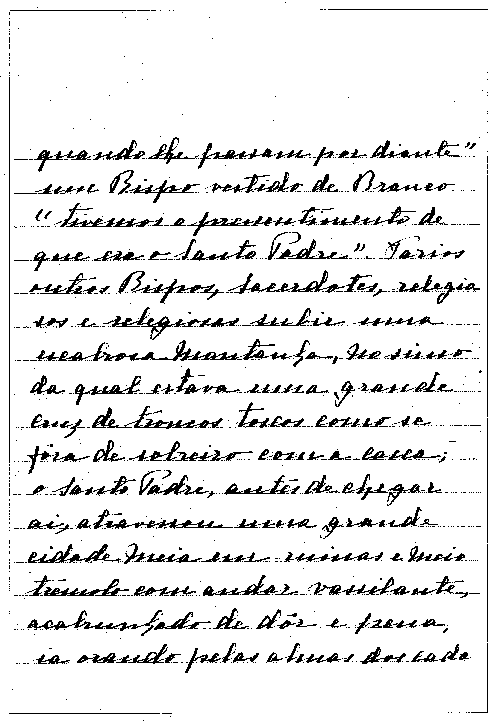
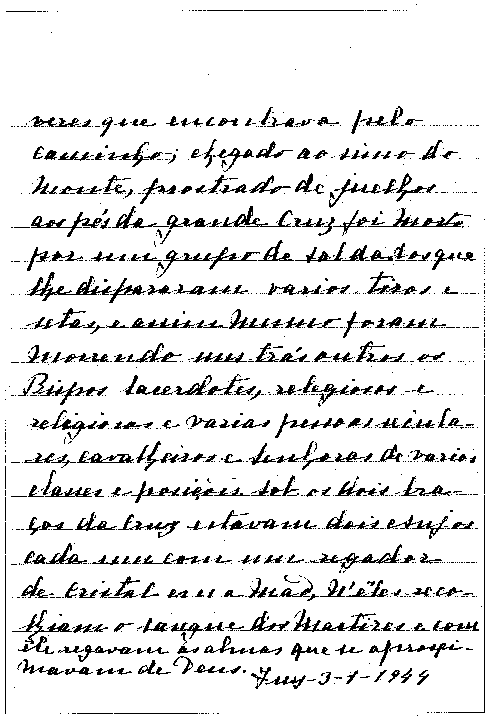
«J.M.J. The third part of the secret revealed at the Cova da Iria-Fatima, on 13 July 1917. I write in obedience to you, my God, who command me to do so through his Excellency the Bishop of Leiria and through your Most Holy Mother and mine. After the two parts which I have already explained, at the left of Our Lady and a little above, we saw an Angel with a flaming sword in his left hand; flashing, it gave out flames that looked as though they would set the world on fire; but they died out in contact with the splendour that Our Lady radiated towards him from her right hand: pointing to the earth with his right hand, the Angel cried out in a loud voice: 'Penance, Penance, Penance!'. And we saw in an immense light that is God: 'something similar to how people appear in a mirror when they pass in front of it' a Bishop dressed in White 'we had the impression that it was the Holy Father'. Other Bishops, Priests, men and women Religious going up a steep mountain, at the top of which there was a big Cross of rough-hewn trunks as of a cork-tree with the bark; before reaching there the Holy Father passed through a big city half in ruins and half trembling with halting step, afflicted with pain and sorrow, he prayed for the souls of the corpses he met on his way; having reached the top of the mountain, on his knees at the foot of the big Cross he was killed by a group of soldiers who fired bullets and arrows at him, and in the same way there died one after another the other Bishops, Priests, men and women Religious, and various lay people of different ranks and positions. Beneath the two arms of the Cross there were two Angels each with a crystal aspersorium in his hand, in which they gathered up the blood of the Martyrs and with it sprinkled the souls that were making their way to God. Tuy-3-1-1944».
INTERPRETATION OF THE «SECRET»
LETTER OF HIS HOLINESS POPE JOHN PAUL II
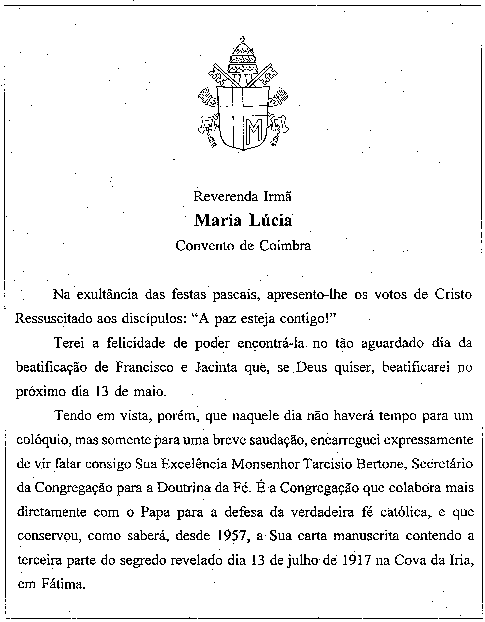
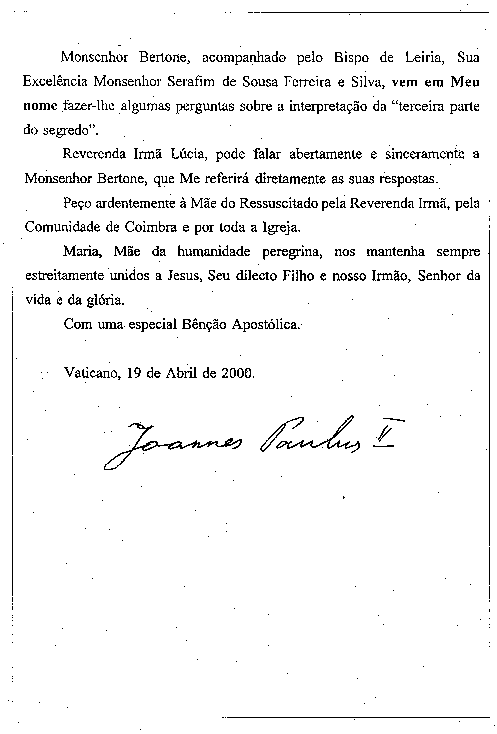
(translation) To the Reverend Sister In the great joy of Easter, I greet you with the words the Risen Jesus spoke to the disciples: «Peace be with you»! I will be happy to be able to meet you on the long-awaited day of the Beatification of Francisco and Jacinta, which, please God, I will celebrate on 13 May of this year. Since on that day there will be time only for a brief greeting and not a conversation, I am sending His Excellency Archbishop Tarcisio Bertone, Secretary of the Congregation for the Doctrine of the Faith, to speak with you. This is the Congregation which works most closely with the Pope in defending the true Catholic faith, and which since 1957, as you know, has kept your hand-written letter containing the third part of the «secret» revealed on 13 July 1917 at Cova da Iria, Fatima. Archbishop Bertone, accompanied by the Bishop of Leiria, His Excellency Bishop Serafim de Sousa Ferreira e Silva, will come in my name to ask certain questions about the interpretation of «the third part of the secret». Sister Maria Lucia, you may speak openly and candidly to Archbishop Bertone, who will report your answers directly to me. I pray fervently to the Mother of the Risen Lord for you, Reverend Sister, for the Community of Coimbra and for the whole Church. May Mary, Mother of pilgrim humanity, keep us always united to Jesus, her beloved Son and our brother, the Lord of life and glory. With my special Apostolic Blessing. IOANNES PAULUS PP. II From the Vatican, 19 April 2000.
CONVERSATION The meeting between Sister Lucia, Archbishop Tarcisio Bertone, Secretary of the Congregation for the Doctrine of the Faith, sent by the Holy Father, and Bishop Serafim de Sousa Ferreira e Silva, Bishop of Leiria-Fatima, took place on Thursday, 27 April 2000, in the Carmel of Saint Teresa in Coimbra. Sister Lucia was lucid and at ease; she was very happy that the Holy Father was going to Fatima for the Beatification of Francisco and Jacinta, something she had looked forward to for a long time. The Bishop of Leiria-Fatima read the autograph letter of the Holy Father, which explained the reasons for the visit. Sister Lucia felt honoured by this and reread the letter herself, contemplating it in own her hands. She said that she was prepared to answer all questions frankly. At this point, Archbishop Bertone presented two envelopes to her: the first containing the second, which held the third part of the «secret» of Fatima. Immediately, touching it with her fingers, she said: «This is my letter», and then while reading it: «This is my writing». The original text, in Portuguese, was read and interpreted with the help of the Bishop of Leiria-Fatima. Sister Lucia agreed with the interpretation that the third part of the «secret» was a prophetic vision, similar to those in sacred history. She repeated her conviction that the vision of Fatima concerns above all the struggle of atheistic Communism against the Church and against Christians, and describes the terrible sufferings of the victims of the faith in the twentieth century. When asked: «Is the principal figure in the vision the Pope?», Sister Lucia replied at once that it was. She recalled that the three children were very sad about the suffering of the Pope, and that Jacinta kept saying: «Coitadinho do Santo Padre, tenho muita pena dos pecadores!» («Poor Holy Father, I am very sad for sinners!»). Sister Lucia continued: «We did not know the name of the Pope; Our Lady did not tell us the name of the Pope; we did not know whether it was Benedict XV or Pius XII or Paul VI or John Paul II; but it was the Pope who was suffering and that made us suffer too». As regards the passage about the Bishop dressed in white, that is, the Holy Father - as the children immediately realized during the «vision» - who is struck dead and falls to the ground, Sister Lucia was in full agreement with the Pope's claim that «it was a mother's hand that guided the bullet's path and in his throes the Pope halted at the threshold of death» (Pope John Paul II, Meditation from the Policlinico Gemelli to the Italian Bishops, 13 May 1994). Before giving the sealed envelope containing the third part of the «secret» to the then Bishop of Leiria-Fatima, Sister Lucia wrote on the outside envelope that it could be opened only after 1960, either by the Patriarch of Lisbon or the Bishop of Leiria. Archbishop Bertone therefore asked: «Why only after 1960? Was it Our Lady who fixed that date?» Sister Lucia replied: «It was not Our Lady. I fixed the date because I had the intuition that before 1960 it would not be understood, but that only later would it be understood. Now it can be better understood. I wrote down what I saw; however it was not for me to interpret it, but for the Pope. Finally, mention was made of the unpublished manuscript which Sister Lucia has prepared as a reply to the many letters that come from Marian devotees and from pilgrims. The work is called Os apelos da Mensagem de Fatima, and it gathers together in the style of catechesis and exhortation thoughts and reflections which express Sister Lucia's feelings and her clear and unaffected spirituality. She was asked if she would be happy to have it published, and she replied: «If the Holy Father agrees, then I am happy, otherwise I obey whatever the Holy Father decides». Sister Lucia wants to present the text for ecclesiastical approval, and she hopes that what she has written will help to guide men and women of good will along the path that leads to God, the final goal of every human longing.The conversation ends with an exchange of rosaries. Sister Lucia is given a rosary sent by the Holy Father, and she in turn offers a number of rosaries made by herself. The meeting concludes with the blessing imparted in the name of the Holy Father.
ANNOUNCEMENT MADE BY CARDINAL ANGELO SODANO At the end of the Mass presided over by the Holy Father at Fatima, Cardinal Angelo Sodano, the Secretary of State, made this announcement in Portuguese, which is given here in English translation: Brothers and Sisters in the Lord! At the conclusion of this solemn celebration, I feel bound to offer our beloved Holy Father Pope John Paul II, on behalf of all present, heartfelt good wishes for his approaching 80th Birthday and to thank him for his vital pastoral ministry for the good of all God's Holy Church; we present the heartfelt wishes of the whole Church. On this solemn occasion of his visit to Fatima, His Holiness has directed me to make an announcement to you. As you know, the purpose of his visit to Fatima has been to beatify the two «little shepherds». Nevertheless he also wishes his pilgrimage to be a renewed gesture of gratitude to Our Lady for her protection during these years of his papacy. This protection seems also to be linked to the so-called third part of the «secret» of Fatima. That text contains a prophetic vision similar to those found in Sacred Scripture, which do not describe photographically the details of future events, but synthesize and compress against a single background facts which extend through time in an unspecified succession and duration. As a result, the text must be interpreted in a symbolic key. The vision of Fatima concerns above all the war waged by atheistic systems against the Church and Christians, and it describes the immense suffering endured by the witnesses of the faith in the last century of the second millennium. It is an interminable Way of the Cross led by the Popes of the twentieth century. According to the interpretation of the «little shepherds», which was also confirmed recently by Sister Lucia, «the Bishop clothed in white» who prays for all the faithful is the Pope. As he makes his way with great difficulty towards the Cross amid the corpses of those who were martyred (Bishops, priests, men and women Religious and many lay people), he too falls to the ground, apparently dead, under a hail of gunfire. After the assassination attempt of 13 May 1981, it appeared evident that it was «a mother's hand that guided the bullet's path», enabling «the Pope in his throes» to halt «at the threshold of death» (Pope John Paul II, Meditation from the Policlinico Gemelli to the Italian Bishops, Insegnamenti, XVII, 1 [1994], 1061). On the occasion of a visit to Rome by the then Bishop of Leiria-Fatima, the Pope decided to give him the bullet which had remained in the jeep after the assassination attempt, so that it might be kept in the shrine. By the Bishop's decision, the bullet was later set in the crown of the statue of Our Lady of Fatima. The successive events of 1989 led, both in the Soviet Union and in a number of countries of Eastern Europe, to the fall of the Communist regimes which promoted atheism. For this too His Holiness offers heartfelt thanks to the Most Holy Virgin. In other parts of the world, however, attacks against the Church and against Christians, with the burden of suffering they bring, tragically continue. Even if the events to which the third part of the «secret» of Fatima refers now seem part of the past, Our Lady's call to conversion and penance, issued at the start of the twentieth century, remains timely and urgent today. «The Lady of the message seems to read the signs of the times - the signs of our time - with special insight... The insistent invitation of Mary Most Holy to penance is nothing but the manifestation of her maternal concern for the fate of the human family, in need of conversion and forgiveness» (Pope John Paul II, Message for the 1997 World Day of the Sick, No. 1, Insegnamenti, XIX, 2 [1996], 561). In order that the faithful may better receive the message of Our Lady of Fatima, the Pope has charged the Congregation for the Doctrine of the Faith with making public the third part of the «secret», after the preparation of an appropriate commentary. Brothers and sisters, let us thank Our Lady of Fatima for her protection. To her maternal intercession let us entrust the Church of the Third Millennium. Sub tuum praesidium confugimus, Sancta Dei Genetrix! Intercede pro Ecclesia. Intercede pro Papa nostro Ioanne Paulo II. Amen. Fatima, 13 May 2000
THEOLOGICAL COMMENTARY A careful reading of the text of the so-called third «secret» of Fatima, published here in its entirety long after the fact and by decision of the Holy Father, will probably prove disappointing or surprising after all the speculation it has stirred. No great mystery is revealed; nor is the future unveiled. We see the Church of the martyrs of the century which has just passed represented in a scene described in a language which is symbolic and not easy to decipher. Is this what the Mother of the Lord wished to communicate to Christianity and to humanity at a time of great difficulty and distress? Is it of any help to us at the beginning of the new millennium? Or are these only projections of the inner world of children, brought up in a climate of profound piety but shaken at the same time by the tempests which threatened their own time? How should we understand the vision? What are we to make of it? Public Revelation and private revelations - their theological status Before attempting an interpretation, the main lines of which can be found in the statement read by Cardinal Sodano on 13 May of this year at the end of the Mass celebrated by the Holy Father in Fatima, there is a need for some basic clarification of the way in which, according to Church teaching, phenomena such as Fatima are to be understood within the life of faith. The teaching of the Church distinguishes between «public Revelation» and «private revelations». The two realities differ not only in degree but also in essence. The term «public Revelation» refers to the revealing action of God directed to humanity as a whole and which finds its literary expression in the two parts of the Bible: the Old and New Testaments. It is called «Revelation» because in it God gradually made himself known to men, to the point of becoming man himself, in order to draw to himself the whole world and unite it with himself through his Incarnate Son, Jesus Christ. It is not a matter therefore of intellectual communication, but of a life-giving process in which God comes to meet man. At the same time this process naturally produces data pertaining to the mind and to the understanding of the mystery of God. It is a process which involves man in his entirety and therefore reason as well, but not reason alone. Because God is one, history, which he shares with humanity, is also one. It is valid for all time, and it has reached its fulfilment in the life, death and resurrection of Jesus Christ. In Christ, God has said everything, that is, he has revealed himself completely, and therefore Revelation came to an end with the fulfilment of the mystery of Christ as enunciated in the New Testament. To explain the finality and completeness of Revelation, the Catechism of the Catholic Church quotes a text of Saint John of the Cross: «In giving us his Son, his only Word (for he possesses no other), he spoke everything to us at once in this sole Word - and he has no more to say... because what he spoke before to the prophets in parts, he has now spoken all at once by giving us the All Who is His Son. Any person questioning God or desiring some vision or revelation would be guilty not only of foolish behaviour but also of offending him, by not fixing his eyes entirely upon Christ and by living with the desire for some other novelty» (No. 65; Saint John of the Cross,The Ascent of Mount Carmel, II, 22). Because the single Revelation of God addressed to all peoples comes to completion with Christ and the witness borne to him in the books of the New Testament, the Church is tied to this unique event of sacred history and to the word of the Bible, which guarantees and interprets it. But this does not mean that the Church can now look only to the past and that she is condemned to sterile repetition. The Catechism of the Catholic Church says in this regard: «...even if Revelation is already complete, it has not been made fully explicit; it remains for Christian faith gradually to grasp its full significance over the course of the centuries» (No. 66). The way in which the Church is bound to both the uniqueness of the event and progress in understanding it is very well illustrated in the farewell discourse of the Lord when, taking leave of his disciples, he says: «I have yet many things to say to you, but you cannot bear them now. When the Spirit of truth comes, he will guide you into all the truth; for he will not speak on his own authority... He will glorify me, for he will take what is mine and declare it to you» (Jn 16:12-14). On the one hand, the Spirit acts as a guide who discloses a knowledge previously unreachable because the premise was missing - this is the boundless breadth and depth of Christian faith. On the other hand, to be guided by the Spirit is also «to draw from» the riches of Jesus Christ himself, the inexhaustible depths of which appear in the way the Spirit leads. In this regard, the Catechism cites profound words of Pope Gregory the Great: «The sacred Scriptures grow with the one who reads them» (No. 94; Gregory the Great,Homilia in Ezechielem I, 7, 8). The Second Vatican Council notes three essential ways in which the Spirit guides in the Church, and therefore three ways in which «the word grows»: through the meditation and study of the faithful, through the deep understanding which comes from spiritual experience, and through the preaching of «those who, in the succession of the episcopate, have received the sure charism of truth» (Dei Verbum, 8). In this context, it now becomes possible to understand rightly the concept of «private revelation», which refers to all the visions and revelations which have taken place since the completion of the New Testament. This is the category to which we must assign the message of Fatima. In this respect, let us listen once again to the Catechism of the Catholic Church: «Throughout the ages, there have been so-called 'private' revelations, some of which have been recognized by the authority of the Church... It is not their role to complete Christ's definitive Revelation, but to help live more fully by it in a certain period of history» (No. 67). This clarifies two things: 1. The authority of private revelations is essentially different from that of the definitive public Revelation. The latter demands faith; in it in fact God himself speaks to us through human words and the mediation of the living community of the Church. Faith in God and in his word is different from any other human faith, trust or opinion. The certainty that it is God who is speaking gives me the assurance that I am in touch with truth itself. It gives me a certitude which is beyond verification by any human way of knowing. It is the certitude upon which I build my life and to which I entrust myself in dying. 2. Private revelation is a help to this faith, and shows its credibility precisely by leading me back to the definitive public Revelation. In this regard, Cardinal Prospero Lambertini, the future Pope Benedict XIV, says in his classic treatise, which later became normative for beatifications and canonizations: «An assent of Catholic faith is not due to revelations approved in this way; it is not even possible. These revelations seek rather an assent of human faith in keeping with the requirements of prudence, which puts them before us as probable and credible to piety». The Flemish theologian E. Dhanis, an eminent scholar in this field, states succinctly that ecclesiastical approval of a private revelation has three elements: the message contains nothing contrary to faith or morals; it is lawful to make it public; and the faithful are authorized to accept it with prudence (E. Dhanis,Sguardo su Fatima e bilancio di una discussione, in La Civiltà Cattolica 104 [1953], II, 392-406, in particular 397). Such a message can be a genuine help in understanding the Gospel and living it better at a particular moment in time; therefore it should not be disregarded. It is a help which is offered, but which one is not obliged to use. The criterion for the truth and value of a private revelation is therefore its orientation to Christ himself. When it leads us away from him, when it becomes independent of him or even presents itself as another and better plan of salvation, more important than the Gospel, then it certainly does not come from the Holy Spirit, who guides us more deeply into the Gospel and not away from it. This does not mean that a private revelation will not offer new emphases or give rise to new devotional forms, or deepen and spread older forms. But in all of this there must be a nurturing of faith, hope and love, which are the unchanging path to salvation for everyone. We might add that private revelations often spring from popular piety and leave their stamp on it, giving it a new impulse and opening the way for new forms of it. Nor does this exclude that they will have an effect even on the liturgy, as we see for instance in the feasts of Corpus Christi and of the Sacred Heart of Jesus. From one point of view, the relationship between Revelation and private revelations appears in the relationship between the liturgy and popular piety: the liturgy is the criterion, it is the living form of the Church as a whole, fed directly by the Gospel. Popular piety is a sign that the faith is spreading its roots into the heart of a people in such a way that it reaches into daily life. Popular religiosity is the first and fundamental mode of «inculturation» of the faith. While it must always take its lead and direction from the liturgy, it in turn enriches the faith by involving the heart. We have thus moved from the somewhat negative clarifications, initially needed, to a positive definition of private revelations. How can they be classified correctly in relation to Scripture? To which theological category do they belong? The oldest letter of Saint Paul which has been preserved, perhaps the oldest of the New Testament texts, the First Letter to the Thessalonians, seems to me to point the way. The Apostle says: «Do not quench the Spirit, do not despise prophesying, but test everything, holding fast to what is good» (5:19-21). In every age the Church has received the charism of prophecy, which must be scrutinized but not scorned. On this point, it should be kept in mind that prophecy in the biblical sense does not mean to predict the future but to explain the will of God for the present, and therefore show the right path to take for the future. A person who foretells what is going to happen responds to the curiosity of the mind, which wants to draw back the veil on the future. The prophet speaks to the blindness of will and of reason, and declares the will of God as an indication and demand for the present time. In this case, prediction of the future is of secondary importance. What is essential is the actualization of the definitive Revelation, which concerns me at the deepest level. The prophetic word is a warning or a consolation, or both together. In this sense there is a link between the charism of prophecy and the category of «the signs of the times», which Vatican II brought to light anew: «You know how to interpret the appearance of earth and sky; why then do you not know how to interpret the present time?» (Lk 12:56). In this saying of Jesus, the «signs of the times» must be understood as the path he was taking, indeed it must be understood as Jesus himself. To interpret the signs of the times in the light of faith means to recognize the presence of Christ in every age. In the private revelations approved by the Church - and therefore also in Fatima - this is the point: they help us to understand the signs of the times and to respond to them rightly in faith. The anthropological structure of private revelations In these reflections we have sought so far to identify the theological status of private revelations. Before undertaking an interpretation of the message of Fatima, we must still attempt briefly to offer some clarification of their anthropological (psychological) character. In this field, theological anthropology distinguishes three forms of perception or «vision»: vision with the senses, and hence exterior bodily perception, interior perception, and spiritual vision (visio sensibilis - imaginativa - intellectualis). It is clear that in the visions of Lourdes, Fatima and other places it is not a question of normal exterior perception of the senses: the images and forms which are seen are not located spatially, as is the case for example with a tree or a house. This is perfectly obvious, for instance, as regards the vision of hell (described in the first part of the Fatima «secret») or even the vision described in the third part of the «secret». But the same can be very easily shown with regard to other visions, especially since not everybody present saw them, but only the «visionaries». It is also clear that it is not a matter of a «vision» in the mind, without images, as occurs at the higher levels of mysticism. Therefore we are dealing with the middle category, interior perception. For the visionary, this perception certainly has the force of a presence, equivalent for that person to an external manifestation to the senses. Interior vision does not mean fantasy, which would be no more than an expression of the subjective imagination. It means rather that the soul is touched by something real, even if beyond the senses. It is rendered capable of seeing that which is beyond the senses, that which cannot be seen - seeing by means of the «interior senses». It involves true «objects», which touch the soul, even if these «objects» do not belong to our habitual sensory world. This is why there is a need for an interior vigilance of the heart, which is usually precluded by the intense pressure of external reality and of the images and thoughts which fill the soul. The person is led beyond pure exteriority and is touched by deeper dimensions of reality, which become visible to him. Perhaps this explains why children tend to be the ones to receive these apparitions: their souls are as yet little disturbed, their interior powers of perception are still not impaired. «On the lips of children and of babes you have found praise», replies Jesus with a phrase of Psalm 8 (v. 3) to the criticism of the High Priests and elders, who had judged the children's cries of «hosanna» inappropriate (cf. Mt 21:16). «Interior vision» is not fantasy but, as we have said, a true and valid means of verification. But it also has its limitations. Even in exterior vision the subjective element is always present. We do not see the pure object, but it comes to us through the filter of our senses, which carry out a work of translation. This is still more evident in the case of interior vision, especially when it involves realities which in themselves transcend our horizon. The subject, the visionary, is still more powerfully involved. He sees insofar as he is able, in the modes of representation and consciousness available to him. In the case of interior vision, the process of translation is even more extensive than in exterior vision, for the subject shares in an essential way in the formation of the image of what appears. He can arrive at the image only within the bounds of his capacities and possibilities. Such visions therefore are never simple «photographs» of the other world, but are influenced by the potentialities and limitations of the perceiving subject. This can be demonstrated in all the great visions of the saints; and naturally it is also true of the visions of the children at Fatima. The images described by them are by no means a simple expression of their fantasy, but the result of a real perception of a higher and interior origin. But neither should they be thought of as if for a moment the veil of the other world were drawn back, with heaven appearing in its pure essence, as one day we hope to see it in our definitive union with God. Rather the images are, in a manner of speaking, a synthesis of the impulse coming from on high and the capacity to receive this impulse in the visionaries, that is, the children. For this reason, the figurative language of the visions is symbolic. In this regard, Cardinal Sodano stated: «[they] do not describe photographically the details of future events, but synthesize and compress against a single background facts which extend through time in an unspecified succession and duration». This compression of time and place in a single image is typical of such visions, which for the most part can be deciphered only in retrospect. Not every element of the vision has to have a specific historical sense. It is the vision as a whole that matters, and the details must be understood on the basis of the images taken in their entirety. The central element of the image is revealed where it coincides with what is the focal point of Christian «prophecy» itself: the centre is found where the vision becomes a summons and a guide to the will of God. An attempt to interpret the «secret» of Fatima The first and second parts of the «secret» of Fatima have already been so amply discussed in the relative literature that there is no need to deal with them again here. I would just like to recall briefly the most significant point. For one terrible moment, the children were given a vision of hell. They saw the fall of «the souls of poor sinners». And now they are told why they have been exposed to this moment: «in order to save souls - to show the way to salvation. The words of the First Letter of Peter come to mind: «As the outcome of your faith you obtain the salvation of your souls» (1:9). To reach this goal, the way indicated - surprisingly for people from the Anglo-Saxon and German cultural world - is devotion to the Immaculate Heart of Mary. A brief comment may suffice to explain this. In biblical language, the «heart» indicates the centre of human life, the point where reason, will, temperament and sensitivity converge, where the person finds his unity and his interior orientation. According to Matthew 5:8, the «immaculate heart» is a heart which, with God's grace, has come to perfect interior unity and therefore «sees God». To be «devoted» to the Immaculate Heart of Mary means therefore to embrace this attitude of heart, which makes the fiat - «your will be done» - the defining centre of one's whole life. It might be objected that we should not place a human being between ourselves and Christ. But then we remember that Paul did not hesitate to say to his communities: «imitate me» (1 Cor 4:16; Phil 3:17; 1 Th 1:6; 2 Th 3:7, 9). In the Apostle they could see concretely what it meant to follow Christ. But from whom might we better learn in every age than from the Mother of the Lord? Thus we come finally to the third part of the «secret» of Fatima which for the first time is being published in its entirety. As is clear from the documentation presented here, the interpretation offered by Cardinal Sodano in his statement of 13 May was first put personally to Sister Lucia. Sister Lucia responded by pointing out that she had received the vision but not its interpretation. The interpretation, she said, belonged not to the visionary but to the Church. After reading the text, however, she said that this interpretation corresponded to what she had experienced and that on her part she thought the interpretation correct. In what follows, therefore, we can only attempt to provide a deeper foundation for this interpretation, on the basis of the criteria already considered. «To save souls» has emerged as the key word of the first and second parts of the «secret», and the key word of this third part is the threefold cry: «Penance, Penance, Penance!» The beginning of the Gospel comes to mind: «Repent and believe the Good News» (Mk 1:15). To understand the signs of the times means to accept the urgency of penance - of conversion - of faith. This is the correct response to this moment of history, characterized by the grave perils outlined in the images that follow. Allow me to add here a personal recollection: in a conversation with me Sister Lucia said that it appeared ever more clearly to her that the purpose of all the apparitions was to help people to grow more and more in faith, hope and love - everything else was intended to lead to this. Let us now examine more closely the single images. The angel with the flaming sword on the left of the Mother of God recalls similar images in the Book of Revelation. This represents the threat of judgement which looms over the world. Today the prospect that the world might be reduced to ashes by a sea of fire no longer seems pure fantasy: man himself, with his inventions, has forged the flaming sword. The vision then shows the power which stands opposed to the force of destruction - the splendour of the Mother of God and, stemming from this in a certain way, the summons to penance. In this way, the importance of human freedom is underlined: the future is not in fact unchangeably set, and the image which the children saw is in no way a film preview of a future in which nothing can be changed. Indeed, the whole point of the vision is to bring freedom onto the scene and to steer freedom in a positive direction. The purpose of the vision is not to show a film of an irrevocably fixed future. Its meaning is exactly the opposite: it is meant to mobilize the forces of change in the right direction. Therefore we must totally discount fatalistic explanations of the «secret», such as, for example, the claim that the would-be assassin of 13 May 1981 was merely an instrument of the divine plan guided by Providence and could not therefore have acted freely, or other similar ideas in circulation. Rather, the vision speaks of dangers and how we might be saved from them. The next phrases of the text show very clearly once again the symbolic character of the vision: God remains immeasurable, and is the light which surpasses every vision of ours. Human persons appear as in a mirror. We must always keep in mind the limits in the vision itself, which here are indicated visually. The future appears only «in a mirror dimly» (1 Cor 13:12). Let us now consider the individual images which follow in the text of the «secret». The place of the action is described in three symbols: a steep mountain, a great city reduced to ruins and finally a large rough-hewn cross. The mountain and city symbolize the arena of human history: history as an arduous ascent to the summit, history as the arena of human creativity and social harmony, but at the same time a place of destruction, where man actually destroys the fruits of his own work. The city can be the place of communion and progress, but also of danger and the most extreme menace. On the mountain stands the cross - the goal and guide of history. The cross transforms destruction into salvation; it stands as a sign of history's misery but also as a promise for history. At this point human persons appear: the Bishop dressed in white («we had the impression that it was the Holy Father»), other Bishops, priests, men and women Religious, and men and women of different ranks and social positions. The Pope seems to precede the others, trembling and suffering because of all the horrors around him. Not only do the houses of the city lie half in ruins, but he makes his way among the corpses of the dead. The Church's path is thus described as a Via Crucis, as a journey through a time of violence, destruction and persecution. The history of an entire century can be seen represented in this image. Just as the places of the earth are synthetically described in the two images of the mountain and the city, and are directed towards the cross, so too time is presented in a compressed way. In the vision we can recognize the last century as a century of martyrs, a century of suffering and persecution for the Church, a century of World Wars and the many local wars which filled the last fifty years and have inflicted unprecedented forms of cruelty. In the «mirror» of this vision we see passing before us the witnesses of the faith decade by decade. Here it would be appropriate to mention a phrase from the letter which Sister Lucia wrote to the Holy Father on 12 May 1982: «The third part of the 'secret' refers to Our Lady's words: 'If not, [Russia] will spread her errors throughout the world, causing wars and persecutions of the Church. The good will be martyred; the Holy Father will have much to suffer; various nations will be annihilated'. In the Via Crucis of an entire century, the figure of the Pope has a special role. In his arduous ascent of the mountain we can undoubtedly see a convergence of different Popes. Beginning from Pius X up to the present Pope, they all shared the sufferings of the century and strove to go forward through all the anguish along the path which leads to the Cross. In the vision, the Pope too is killed along with the martyrs. When, after the attempted assassination on 13 May 1981, the Holy Father had the text of the third part of the «secret» brought to him, was it not inevitable that he should see in it his own fate? He had been very close to death, and he himself explained his survival in the following words: «... it was a mother's hand that guided the bullet's path and in his throes the Pope halted at the threshold of death» (13 May 1994). That here «a mother's hand» had deflected the fateful bullet only shows once more that there is no immutable destiny, that faith and prayer are forces which can influence history and that in the end prayer is more powerful than bullets and faith more powerful than armies. The concluding part of the «secret» uses images which Lucia may have seen in devotional books and which draw their inspiration from long-standing intuitions of faith. It is a consoling vision, which seeks to open a history of blood and tears to the healing power of God. Beneath the arms of the cross angels gather up the blood of the martyrs, and with it they give life to the souls making their way to God. Here, the blood of Christ and the blood of the martyrs are considered as one: the blood of the martyrs runs down from the arms of the cross. The martyrs die in communion with the Passion of Christ, and their death becomes one with his. For the sake of the body of Christ, they complete what is still lacking in his afflictions (cf. Col 1:24). Their life has itself become a Eucharist, part of the mystery of the grain of wheat which in dying yields abundant fruit. The blood of the martyrs is the seed of Christians, said Tertullian. As from Christ's death, from his wounded side, the Church was born, so the death of the witnesses is fruitful for the future life of the Church. Therefore, the vision of the third part of the «secret», so distressing at first, concludes with an image of hope: no suffering is in vain, and it is a suffering Church, a Church of martyrs, which becomes a sign-post for man in his search for God. The loving arms of God welcome not only those who suffer like Lazarus, who found great solace there and mysteriously represents Christ, who wished to become for us the poor Lazarus. There is something more: from the suffering of the witnesses there comes a purifying and renewing power, because their suffering is the actualization of the suffering of Christ himself and a communication in the here and now of its saving effect. And so we come to the final question: What is the meaning of the «secret» of Fatima as a whole (in its three parts)? What does it say to us? First of all we must affirm with Cardinal Sodano: «... the events to which the third part of the 'secret' of Fatima refers now seem part of the past». Insofar as individual events are described, they belong to the past. Those who expected exciting apocalyptic revelations about the end of the world or the future course of history are bound to be disappointed. Fatima does not satisfy our curiosity in this way, just as Christian faith in general cannot be reduced to an object of mere curiosity. What remains was already evident when we began our reflections on the text of the «secret»: the exhortation to prayer as the path of «salvation for souls» and, likewise, the summons to penance and conversion. I would like finally to mention another key expression of the «secret» which has become justly famous: «my Immaculate Heart will triumph». What does this mean? The Heart open to God, purified by contemplation of God, is stronger than guns and weapons of every kind. The fiat of Mary, the word of her heart, has changed the history of the world, because it brought the Saviour into the world - because, thanks to her Yes, God could become man in our world and remains so for all time. The Evil One has power in this world, as we see and experience continually; he has power because our freedom continually lets itself be led away from God. But since God himself took a human heart and has thus steered human freedom towards what is good, the freedom to choose evil no longer has the last word. From that time forth, the word that prevails is this: «In the world you will have tribulation, but take heart; I have overcome the world» (Jn 16:33). The message of Fatima invites us to trust in this promise.
JosephCard. Ratzinger
(1) From the diary of John XXIII, 17 August 1959: «Audiences: Father Philippe, Commissary of the Holy Office, who brought me the letter containing the third part of the secrets of Fatima. I intend to read it with my Confessor».
(2) The Holy Father's comment at the General Audience of 14 October 1981 on «What happened in May: A Great Divine Trial» should be recalled: Insegnamenti di Giovanni Paolo II, IV, 2 (Vatican City, 1981), 409-412. (3) Radio message during the Ceremony of Veneration, Thanksgiving and Entrustment to the Virgin Mary Theotokos in the Basilica of Saint Mary Major: Insegnamenti di Giovanni Paolo II, IV, 1 (Vatican City, 1981), 1246. (4) On the Jubilee Day for Families, the Pope entrusted individuals and nations to Our Lady: Insegnamenti di Giovanni Paolo II, VII, 1 (Vatican City, 1984), 775-777. (5)
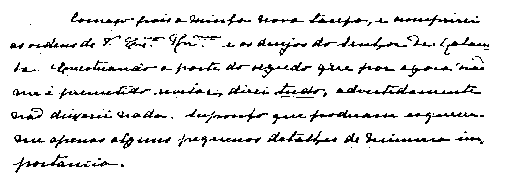
(6) In the «Fourth Memoir» of 8 December 1941 Sister Lucia writes: «I shall begin then my new task, and thus fulfil the commands received from Your Excellency as well as the desires of Dr Galamba. With the exception of that part of the Secret which I am not permitted to reveal at present, I shall say everything. I shall not knowingly omit anything, though I suppose I may forget just a few small details of minor importance».
(7) In the «Fourth Memoir» Sister Lucia adds: «In Portugal, the dogma of the faith will always be preserved, etc. ...».
(8) In the translation, the original text has been respected, even as regards the imprecise punctuation, which nevertheless does not impede an understanding of what the visionary wished to say.
|

05. KÖR – DAGLIG PREDIKAN – f
Administratör
Administratör
•
2H sedan
Vittnesbörd & Tro
2
Visa källa
Prenumererad
V. FASTEVECKA – FREDAG, CORK
5 – Dagligen
Joh
10:31-42: De ville ta honom, men han undkom från deras hand.
Fredagen före fredagen för Herrens lidande läser kyrkan för oss några verser ur Jeremias "Bekännelser". De är inte som t.ex. Augustinus, där Gud endast är förhärligad och samtidigt ens egna otrohet erkänns. Så här kan varje själ tala när den tänker på sig själv och vad Gud har gjort för den, men det är annorlunda när man känner hela tyngden av den uppgift som Gud anförtrott någon för andra. Ur detta perspektiv är det lätt att förstå att Gamla testamentets profeters roll varken var trevlig eller enkel. Profeten Jeremia upplevde fientlighet och förföljelse under hela sitt liv. I dagens första läsning beklagas det: 'Jag har hört många förtal: 'Skräck från alla håll! Rapport. Vi kommer att anmäla honom.' Alla som var mina vänner väntade på mitt fall. 'Kanske kommer vi att förföra honom, och vi ska bemästra honom och hämnas på honom!' Hans liv liknar livet för hans folk som stod inför en katastrof. Han var tvungen att ständigt varna folket som han älskade och döma dem. Det är därför han utsattes för hån och fientlighet. Dagens text, särskilt om vi läser den i ett bredare sammanhang, visar all bitterhet som samlats i hans hjärta. Det är därför det varken är förvånande eller förvånande att be om hämnd: 'Låt mig se hur du hämnas på dem'.
Men den talar inte om hat, utan om överdriven smärta och profetens visshet om att Gud står på hans sida. Han är medveten om att Gud är med honom som en "stark hjälte" som har lovat honom hjälp och skydd. Det är därför hans motståndare kommer att snubbla, de kommer att skämmas, de kommer inte att besegra honom, de kommer inte att lyckas. Gud styr hans stämning, och det är därför profeten, trots allt motstånd, är säker på seger. Gud överger inte dem som litar på honom. Detta gäller Jeremia, men det gäller också oss. Gud kommer inte heller att överge oss om vi fast tror och sätter all vår tillit till Honom så att vi inte vacklar i livets stormar. Och av erfarenhet, och från Guds ord, vet vi att vedermödan, korset, är en väsentlig del av arvet hos den som följer Kristus. Precis som Kristus frälste människan med korset, så kommer människan själv, bärande sitt kors, till frälsningens väg och samarbetar i världens frälsning. vilket också sades av St. Paulus: "I mitt kött kompenserar jag det som saknas i Kristi lidanden för hans kropp, för kyrkan" (Kol 1:24). Det är med sådan självsäkerhet, som nämnts ovan, som vi närmar oss Herren med psalmisten i psalmen: 'Min Gud, min grotta, till vilken jag har en vändning, skydda mig, min frälsningskraft, min fästning! Jag ska åkalla Herren, den mest lovvärde, och jag ska bli befriad från fienden.'
Igår i evangeliet såg vi hur Jesus blev stenad av sina motståndare i templet, men han undkom dem. I början av dagens evangelium läser vi igen: 'Judarna tog återigen stenar för att stena Jesus. Jesus svarade dem: 'Jag har visat er många goda gärningar av Fadern. För vilka gärningar av dessa stenar du mig?" Och diskussionen som började i gårdagens evangelium fortsätter. De svarar honom: 'Vi stenar dig inte för goda gärningar, utan för hädelse: för du – trots allt bara människa – gör dig till Gud'. Jesus svarar med orden i Psalm 82: "Jag sa att ni är gudar", varpå han vill visa att hans ord inte är hädelse mot Gud, för om domare kunde kallas "gudar" på grund av sin ställning, hur kan det då kallas hädelse om han utropar sig själv till "Guds Son" som Fadern helgade och sände ut i världen. Jesus hänvisar dessutom till sina gärningar (mirakler) som han utför, eftersom dessa verk talar vältaligt om hans gudomlighet, eftersom de i själva verket är Faderns gärningar. Här möter vi motsättningen mellan tro och otro. Ingen förblir likgiltig inför Jesus. För judarna på Jesu tid, liksom för de otroende i alla tider och på alla platser, förblir Jesu mysterium hädiskt, att han gör sig själv till Gud, trots så många "goda gärningar", tecken och under som han har gjort och fortsätter att göra i sin kyrka. För troende är Jesus Guds Son, Budbäraren och den ende medlaren mellan Gud och människor, världens ljus, människors liv. Hans död och uppståndelse är förhärligandet av Fadern och Sonen, fullbordandet av frälsningens verk för alla människor. Och endast Jesus är vägen som leder till Guds fulla sanning och till evigt liv. Låt oss därför veta att vi varje dag ska känna igen denna väg mer och mer, att följa den, och detta betyder: att ständigt bli omvända, så att vi kan komma så säkert som möjligt till detta eviga liv, som Jesus Kristus förkunnade för oss och säkrade för oss med sin lidande.
https://www.sverigesradio.se/artikel/dietistbrist-hotar-aldre-kommunerna-saknar-kunskap
Gudstjanstordning-v.-13-2026.pdf
https://x.com/SkyVirginSon/status/2037135327542890539?s=20
OmiBreviar-norsk
Start
Månads liturgi
2026-03-27 - 2026-04-26
________________________________
2026-03-27fredag i 5 fasteveckan
fredagHes 37:21-28, Ps Jer 31:10-13, Joh 11:45-56
________________________________
2026-03-28lördag i 5 fasteveckan
lördagJer 20:10-13, Ps 17, Joh 10:31-42
________________________________
2026-03-29Palmsöndagen
söndagJes 50:4-7, Ps 22, Fil 2:6-11, Matt 26:14-27:66
________________________________
2026-03-30måndag i stilla veckan
måndagJes 42:1-7, Ps 27, Joh 12:1-11
________________________________
2026-03-31tisdag i stilla veckan
tisdagJes 49:1-6, Ps 71, Joh 13:21-33,36-38
________________________________
2026-04-01onsdag i stilla veckan
onsdagJes 50:4-9a, Ps 69, Matt 26:14-25
________________________________
2026-04-02Skärtorsdag
torsdag2 Mos 12:1-8,11-14, Ps 116, 1 Kor 11:23-26, Joh 13:1-15
________________________________
2026-04-03Långfredag
fredagJes 52:13-53:12, Ps 31, Heb 4:14-16,5:7-9, Joh 18:1-19:42
________________________________
2026-04-04Påskafton
lördagRom 6:3-11, Matt 28:1-10
________________________________
2026-04-05Påskdagen - Kristi Uppståndelse
söndagApg 10:34a,37-43, Ps 118, Kol 3:1-4, Joh 20:1-9
________________________________
2026-04-06Annandag påsk
måndagApg 2:14,22-33, Ps 16, Matt 28:8-15
________________________________
2026-04-07tisdag i påskoktaven
tisdagApg 2:36-41, Ps 33, Joh 20:11-18
________________________________
2026-04-08onsdag i påskoktaven
onsdagApg 3:1-10, Ps 105, Luk 24:13-35
________________________________
2026-04-09torsdag i påskoktaven
torsdagApg 3:11-26, Ps 8, Luk 24:35-48
________________________________
2026-04-10fredag i påskoktaven
fredagApg 4:1-12, Ps 118, Joh 21:1-14
________________________________
2026-04-11lördag i påskoktaven
lördagApg 4:13-21, Ps 118, Mark 16:9-15
________________________________
2026-04-12Andra Påsksöndagen
söndagApg 2:42-47, Ps 118, 1 Pet 1:3-9, Joh 20:19-31
________________________________
2026-04-13måndag i 2 påskveckan
måndagApg 4:23-31, Ps 2, Joh 3:1-8
________________________________
2026-04-14tisdag i 2 påskveckan
tisdagApg 4:32-37, Ps 93, Joh 3:7b-15
________________________________
2026-04-15onsdag i 2 påskveckan
onsdagApg 5:17-26, Ps 34, Joh 3:16-21
________________________________
2026-04-16torsdag i 2 påskveckan
torsdagApg 5:27-33, Ps 34, Joh 3:31-36
________________________________
2026-04-17fredag i 2 påskveckan
fredagApg 5:34-42, Ps 27, Joh 6:1-15
________________________________
2026-04-18lördag i 2 påskveckan
lördagApg 6:1-7, Ps 33, Joh 6:16-21
________________________________
2026-04-19Tredje Påsksöndagen
söndagApg 2:14,22-33, Ps 16, 1 Pet 1:17-21, Luk 24:13-35
________________________________
2026-04-20måndag i 3 påskveckan
måndagApg 6:8-15, Ps 119, Joh 6:22-29
________________________________
2026-04-21tisdag i 3 påskveckan
tisdagApg 7:51-8:1a, Ps 31, Joh 6:30-35
Anselm av Canterbury biskop och kyrkolärare
Född i Piemonte år 1033, blev benediktin i klostret Le Bec i Normandie, undervisade i teologi och förde ett strängt asketiskt liv. Som ärkebiskop av Canterbury kämpade han för kyrkans oberoende och drevs två gånger i landsflykt. I sina skrifter har han bl.a. formulerat det s.k. ontologiska gudsbeviset. Dog är 1109.
________________________________
2026-04-22onsdag i 3 påskveckan
onsdagApg 8:1b-8, Ps 66, Joh 6:35-40
________________________________
2026-04-23torsdag i 3 påskveckan
torsdagApg 8:26-40, Ps 66, Joh 6:44-51
Georg martyr, Adalbert biskop och martyr
Georg. Redan under 300-talet vördades han som martyr i Lydda, Palestina, där en kyrka kom att uppföras till hans ära. Georgskulten utbreddes tidigt i både öst och väst. Han var soldat och säges ha dött i Lydda, men ingen vet när.
Adalbert. Född i Libice i Böhmen omkring 956. Studerade i Magdeburg och antog vid konfirmationen namnet Adalbert. Åter i hemlandet prästvigdes han 983 och blev Prags andre biskop, som energiskt verkade för utrotandet av hedniska sedvänjor. När han misslyckades i denna verksamhet begav han sig till Rom och blev där munk. Under ett nytt försök att missionera, denna gång i Preussen, dödades han av sina motståndare den 23 april 997.
________________________________
2026-04-24fredag i 3 påskveckan
fredagApg 9:1-20, Ps 117, Joh 6:52-59
Fidelis av Sigmaringen präst och martyr
Föddes i Sigmaringen i Sydtyskland 1578. Efter att först ha varit advokat inträdde han i kapucinorden och förde ett strängt asketiskt liv, Outtröttlig som predikant fick han i uppdrag att stärka den katolska tron i Schweiz, där han 1622 dödades av calvinistiska bönder. Juristernas skyddshelgon.
________________________________
2026-04-25Markus evangelist
lördag1 Pet 5:5b-14, Ps 89, Mark 16:15-20
Av de fyra evangelierna är Markus det äldsta. Troligen skrevs det i Rom och återger bl.a. Petrus predikan och minnen. Han följde Paulus på den första missionsresan, kom senare till Rom. Hans mor upplät sitt hemför den första församlingen i Jerusalem.. Kyrkan i Alexandria vördar honom som sin grundare. Hans dag firades först bara i östkyrkan men ingår fr.o.m. 1000-talet även i den romerska kalendern.
Vittnesbörd & Tro
Tro kräver mod. Tro kräver mod som överträffar sig själva.
Meny
Vittnesbörd & Tro
02. KOR – Marys tankar – e
JesusII. FASTEVECKAN – TORSDAG
02 KOR – Varje dag
Han sitter där på tullkontoret, en man med skumma affärer och en bedragare som manipulerar skatter för egen vinning, som tar hårt förvärvade pengar ur folks fickor och samtidigt samarbetar med de romerska ockupanterna. – Alla hatar honom. Jesus ser honom och tilltalar, som i förbifarten, orden: Du, följ med mig! Ja, du, jag tänker på dig! Och denna man lämnar allt, reser sig, följer Jesus, som om han väntade på att någon äntligen skulle kalla på honom, så att han kan leva annorlunda än tidigare. Om och om igen bjuder Jesus in människor som står åt sidan och sätter sig själv över alla moraliska och religiösa barriärer, till de frommas förvåning. Och Jesus bryr sig om dem: Du behöver ingen läkare, du är frisk, men varför blir du skandaliserad om jag hjälper någon som längtar efter att bli annorlunda? Varför tror du att jag var tvungen att ge Levi en moralisk läxa först? Var istället tacksam för att ditt liv är kopplat till Gud, förstör inte den förbindelsen genom att höja dig själv över dem som behöver hjälp. Gud sätter inga gränser, han gläds åt alla som gått förlorade och låter sig nu bli funnen.
Jesus böjde sig ner och började skriva på marken med sitt finger. Och medan de fortsatte, reste han sig och sade till dem: "Den av er som är utan synd, låt honom vara den första att kasta en sten på henne." Och när de hörde detta började de gå en efter en, med början hos de äldste. Jesus blev ensam kvar – och kvinnan stod i mitten. Jesus reste sig och sade till henne: 'Kvinna, var är de? Och hon sade: Ingen, Herre, och Jesus sade till henne: Inte heller dömer jag dig. Gå och synda inte mer.'"
Pris:2 röster
Dela detta:
E-post
Tryck på detta
Spara
Läs mer
Relaterat
04. KORINTHIERBREVET – BIBLISK TANKE PÅ DAGEN – g
I "Biblical Thought of the Day"
När jag först träffade dig (04. KOR)
I "Fastan"
05. KÖR – DAGLIG PREDIKAN – f
I "Fastan"
Avatar av det Okända.Squirt AdministratörPublicerad på5 mars 2026GalleriFastan, Marys tankar
Efternavigering
Tidigare
Föregående inlägg:02. KORINTHIERBREVET – BIBELNS TANKE PÅ DAGEN – e
Nästa
Nästa inlägg:02. KÖR – KVÄLLSBÖN – e
Utcheckning
Utcheckning
Mars 2026
P U S Č P S N
1
2
3
4
5
6 7 8
9
10
11
12
13
14
15
16
17
18
19
20 21 22
23 24 25 26
27
28 29
30 31
« Äkta.
Arkiv
Arkiv
Utvald månad
Statistikbloggen
5 155 056 besök
BöneintentionBöneintention
EN KRAFTFULL BÖN OM BEFRIELSE FRÅN LÖGNENS ANDE OCH FRÅN VARJE SATANISKT GIFT!EN KRAFTFULL BÖN OM BEFRIELSE FRÅN LÖGNENS ANDE OCH FRÅN VARJE SATANISKT GIFT!
DEN FALSKA SANNINGSBOKEN, DEN FALSKA SIGILLEN FRÅN DEN LEVANDE GUDEN OCH DEN FALSKA PROFETISSANDEN FALSKA SANNINGSBOKEN, DEN FALSKA SIGILLEN FRÅN DEN LEVANDE GUDEN OCH DEN FALSKA PROFETISSAN
28. NKG - ETT ORD FÖR DIG - A28. NKG - ETT ORD FÖR DIG - A
0308 - Böner från Saligheten. Augustin Kažotić ber om nåd0308 - Böner från Saligheten. Augustin Kažotić ber om nåd
Novena till det Heliga AnsiktetNovena till det Heliga Ansiktet
2511 - Sankta Katarina - seder2511 - Sankta Katarina - seder
BESATTHET OCH EXORCISMBESATTHET OCH EXORCISM
Livet är en kampLivet är en kamp
05. KÖR - DAGLIG PREDIKAN - f05. KÖR - DAGLIG PREDIKAN - f
Galleri
BDM
Festdag
Kyrkoår
Juletid
Nyårsafton
Advent
Herrens fester
Herrens bebådelse, bebådelsen
Den Heliga Treenigheten
Herrens frambärande
Corpus Christi
Upphöjelsen av det Heliga Korset
Fastan
Herrens passionssöndag. Palmsöndagen
Stilla veckan
Liturgiår A
Liturgiskt år B
Liturgiskt år C
Rörliga festligheter
Firanden av den saliga Jungfru Maria och helgonen
Firanden av den saliga Jungfru Maria
Helgonfiranden
Dagens helgon
Alojzije Stepinac
Antonius av Padua
Helgonens liv
Minnesdagen
Påsktid
Spöken
Herrens uppståndelsesöndag
Herrens himmelsfärd – Frälsningen
Påsktriduum
Påskafton
Långfredagen
Skärtorsdagen
Tid under året
Gallerier
Fru.
När himlen talar
Katolska kyrkans katekes
Ett hörn för själen
Citat, talesätt och tankar
Bibelcitat
Citat på bilden
Tankar om Gud
Tankar om kärlek
Om Gud och kärlek
Jesus säger det till dig
Lärorika berättelser
Överväganden
Ett ord till dig
Ett litet skämt skadar inte själen
Mary talar till dig
Marys tankar
Mässläsningar
ÅR I (udda år)
ÅR II (jämnt år)
Böner och andakter
Novena
Dagliga böner
Morgonbön
Kvällsbön
Korta böner
Korsets väg
Rosenkransen
Litanior
Böner
Böner som varje kristen behöver känna till
Våra farmödrars böner
Böner till helgonen
Böner till Sankta Rita
St. Joseph
Böner för helgonen
Triduum
Böneintentioner
Ofödd
Tillkännagivanden & Evenemang
Påve Franciskus _ angelus
Sångbok
Fastensånger
Predikningar
Biblisk tanke för dagen
Filips korta predikningar
Söndagspredikningar
Påvens Angelus-tal
Ett ord från en präst till dig
Helgedomar
Firande
Vittnesmål
Religiös utbildning
Om äktenskap
Intressant
Trons korn
Tidskrift
PÅSK
Grattis
Läsare skriver
https://poddtoppen.se/podcast/1794728947/vox-populi
https://youtu.be/hRMBo1IKDsE?si=GjJANrp1E5kSWIJV
St. Joseph’s Heart
5 mars
@stjosephsheart
Joseph hours:
- Wake up
- Make the sign of the cross
- Morning offering
- Psalm 95 (invitatory)
- Lift
- Get ready for work
Glorify the Lord in hidden holiness
27 mar 2026
Skip to content
F A U S T I N U M P LF A U S T I N U M P L
Officiell webbplats för Föreningen för Apostlarna av Gudomlig Barmhärtighet "Faustinum"
PL2
GB
es
fr
sk2
det
Hem
Om oss
Zaproszenie
Poznaj Stowarzyszenie
Członkowie i wolontariusze
Zostań wolontariuszem
Zostań członkiem
Historia „Faustinum”
Siedziba Stowarzyszenia
Statut
Den andliga vägen
Powołanie
Modlitwa
Formacja
Apostolstwo
Świadectwa
Formningsmaterial
Konferencje formacji podstawowej
Przesłanie o Bożym miłosierdziu
Zawierzyć Miłosierdziu w czasie próby
Droga ze św. Faustyną
Międzynarodowe Kongresy ABM
Konferencje
Artykuły
Uczynki miłosierdzia
Publikationer
Formacja podstawowa
Formacja permanentna
Dokumenty Kościoła o miłosierdziu
CD
„Orędzie Miłosierdzia”
“JA zawsze JESTEM z tobą”
Polecamy
Do pobrania
Kontakt
HemLjusets mysterier i Marias hjärta
Ljusets mysterier i Marias hjärta
Väg
Vill du gå med
Till oss?
Läs mer
Faustinum
RETRÄTT
BILDANDE
SAMHÄLLEN
Skicka avsikt
Avsikter
Ser du, lyssna
Kategorier
Kategorie
Välj en kategori
Arkiv
Archiwa
Utvalt månad
1 år av Faustinum-formation 2:a året av grundläggande utbildning Barmhärtighetens apostel Barmhärtighetens apostlar ABC av andlig livscykel Bibelcykel Syster Faustina Medlemmar Faustinum Dagbok Faustinum Faustinum Faustinum i Krakow Faustina Faustinum Formation Faustinum Grundutbildning Faustinum Galleri Jesus, jag litar på dig Krakow Faustinum gemenskapsmaterial Barmhärtighetsbön Bön med St. Faustina Be med Guds ord Be med Faustina Płock Faustinum gemenskap Faustinum Retreat Faustinum Retreat i tystnad Retreat i tystnad Retreat i tystnad Retreat i Łagiewniki Retreat med Bibeln och dagboken från St. Faustina Helgedomen för Guds barmhärtighet Helgedomen i Płock-helgedomen i Łagiewniki Bildningsmöte Bildningsmöte i Krakow Bildningsmöte i Płock Faustinum Föreningens Ord om Gud Lyssna till Ordet med St. Faustina Faustinum Volontärer Faustinum Gemenskap Gemenskap i Krakow Gemenskap i Płock-kongregationen av Systrarna av Vår Fru av Barmhärtighet Vittnesbörd om St. Faustina
MAHp
Maria Agstam Häggkvist, präst
Tankar inför helgen 27 mars 2026 Lästid 3 minuter
Palmsöndagen
Kan vi inte hoppa över det mörka?
Nu ser vi fram emot vårens ljus och påskens glädje. Behöver vi verkligen gå igenom fasta och mörker för att komma dit? Kan vi inte hoppa över det mörka och gå direkt på ljuset? Vart går vägen till korset och var stannar den? Stannar den ens? Stannar den bara till? Kanske visar den sig vara en vägkorsning där vägen fortsätter bortom korset?
På bilden ser i en skogsväg. Träden på båda sidorna är mörka, men det strömmar ljus över stigen, inte uppifrån, utan från solen som är bakom skogen. En hoppfull strimma ljus lyser över stigen, mitt i mörkret.
Påsken närmar sig. Jag tycker om påsken. Det blir fint med god mat, påskägg med godis och ett slags löfte om vår. Påskens grund handlar om ljus, glädje, uppståndelse och liv som övervinner allt, till och med döden. Eller ja, så slutar påsken i alla fall. Det är ju ändå en tid innan av fasta och faktiskt av död, innan vi kommer till påsken. Hela påskveckan, från palmsöndagen genom skärtorsdagens sista måltid och ner i dödens djup på långfredagen och tystnadens stillhet på påskafton, handlar om en väg mot ett till synes oundvikligt kors. En väg som stannar där, vid korset. Ibland tänker jag att det vore skönt att slippa det där innan, att gå direkt på det fina och glada. Men allt hör ihop. Det ena funkar inte utan det andra.
På palmsöndagen är rubriken på bibeltexterna i våra kyrkor ”Vägen till korset”.
Det låter verkligen inte som någon festlig väg mot påskens glädje, mot ägg, godis och påskliljor, när våren är här och första tussilagon syns i diket en varm dag. Det vore skönt att hoppa över det där med korset och gå direkt på det festliga.
Men påskens berättelse innehåller alltihop och våra liv innehåller alltihop. Dom flesta av oss har berättelser om mörker i våra liv. En väg mot ett kors, vare sig vi visste åt vilket håll vi gick eller inte. Och våra livsvägar har ibland gått runt i det där dödsmörka, utan egentlig riktning eller ljusning i sikte.
Påskveckans riktning är framåt, igenom. Vägen till korset är plågsam, och tiden vid korset är mörk på riktigt. Men vi stannar inte där. Vägen till korset slutar i en vägkorsning, men sen leder den vidare, från korset och in i påskens glädje.
Vi kan inte hoppa över påskveckans mörker, lika lite som vi kan snabbspola mörka tider i våra liv. Jag tror att den enda vägen är vägen igenom, och först när vi orkat och vågat vara i mörkret en tid kan vi hitta ljuset – eller kanske hittar ljuset oss.
Och vägen till korset går vi inte ensamma. Den är upptrampad av den som gick före, och när vi går den så går vi med hela den världsvida kyrkan. Jag tänker också att Gud går med oss. Hela vägen. Annars skulle jag nog inte våga och orka stanna till i det mörka, om jag inte kunde lita på att Gud är med. Eller finna kraften att gå vidare i vägkorsningen, att vandra mot ljuset igen.
Min bön: Gud var med mig i mitt livs korsvandring, stanna med mig när det är mörkt, och hjälp mig att komma igenom, ut på andra sidan korset, där ljuset möter oss igen. Amen.
Publicerad
27 mars, 2026
Maria Agstam Häggkvist
TANKARINFORHELGEN
https://youtu.be/FW6aMyxa8so?si=XgxvLhZv-mak5u9C
GABRIJELA BARAN IMA KONJE I PRAVI SVOJ SIR CROATIA HR

Vilka vi är
Kapucinerbröderna är den yngsta familjen bland de mindre bröderna av Sankt Franciskus av Assisi. Det har alltid funnits en stark utmaning i Franciskus rörelse att förnya i den ursprungliga andan. Alltså, nej. Matthew da Bascio och de första bröderna startade ett nytt brödraskap av bröderna mindre. Kapucinerbröder med franciskaner och minoriter, idag lever och fortsätter vi Franciskus karisma i kyrkan och i världen.
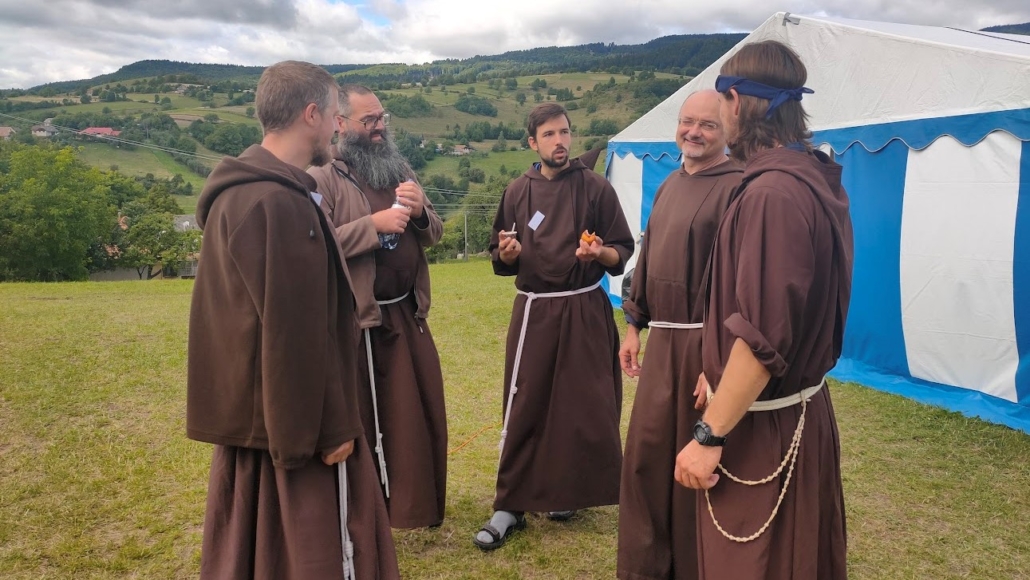
Den yngsta familjen av bröderna Minor av St. Franciskus av Assisi
Under den katolska förnyelsen på 1600-talet spreds kapucinermunkarna över hela Europa och kom även till slovensk mark, där vi enligt välkända predikanter strävade efter att bevara den katolska tron, särskilt bland vanligt folk.
Kyrkans missionsutmaning har spridit kapucinerbröderna över hela världen. Än idag finns det många missionsbröder.
Kloster i Slovenien
I Slovenien bor vi i fem brödraskap och på en och samma plats
Bröderna i Ljubljana, Celje, Maribor, Vipavski Križ och Kančevci arbetar också i församlingar som drivs av kapucinerbröderna, medan andra finns tillgängliga för olika former av apostolisk verksamhet i kyrkan i Slovenien. Det senare gäller även bröderna i Škofja Loka.

De kopplar oss samman
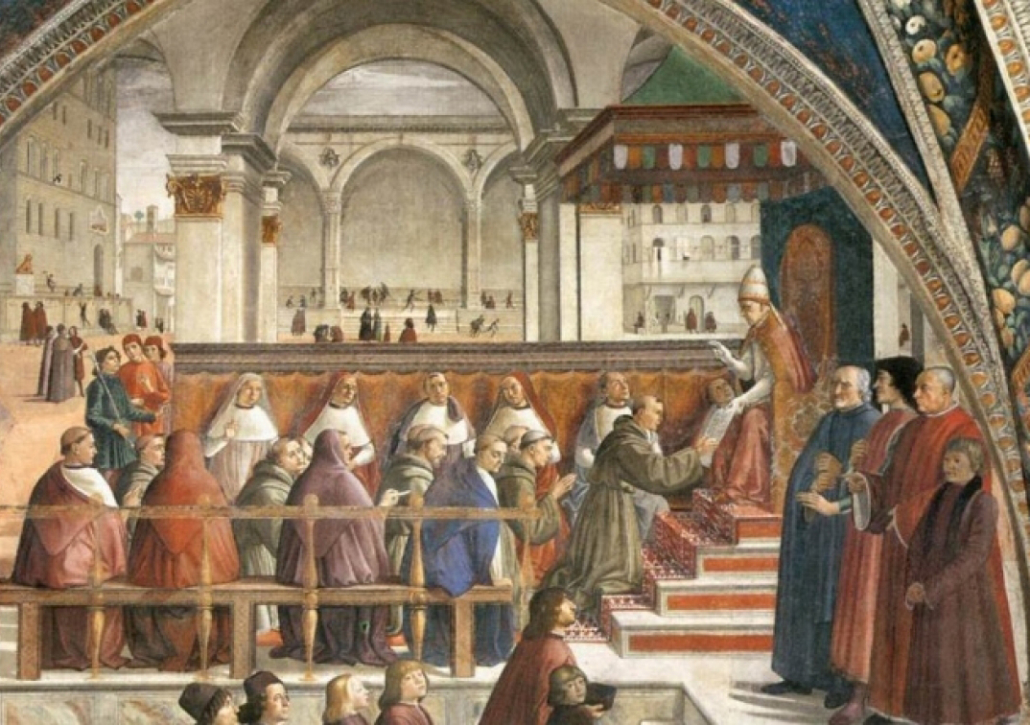
Ordens regler och konstitutioner för Orden
Det som alla kapuciner har gemensamt med oss är våra konstitutioner.
Passiontide, the Veil of Veronica, and Georges Rouault’s Miserere et Guerre
On what it means to see through the eyes of Veronica
|

| |||||||||||||||


 |
“As Jesus toils along up the hill, covered with the sweat of death, a woman makes her way through the crowd, and wipes His face with a napkin. In reward of her piety the cloth retains the impression of the Sacred Countenance upon it.”—from John Henry Newman’s Stations of the Cross
Last Sunday marked the beginning of Passiontide, the season in which we direct our attention to Christ’s passion and death. During this time, churches veil images and statues as we prepare for Easter, excepting the Stations of the Cross. This is because the Stations help us to contemplate Christ’s passion in a special way.
The sixth station presents for our contemplation Veronica’s meeting with Christ. In the traditional story, Veronica finds Jesus as He carries his cross to Golgotha and, in an act of compassion, offers Him her veil to wipe His face. He leaves her with an image of His face on her veil. Fittingly, Veronica’s name means “Vera-icon, or true image.” There are many accounts of healing miracles associated with the veil, but the story is best known for its place in the Stations of the Cross.

Today I would like to turn to images of Veronica’s veil in the art of the 20th century Catholic painter, Georges Rouault. This image is central to Rouault's body of work. He contemplated this moment for many years and painted the veil over and over throughout his life. I have included a few of these images below.
 |
Georges Rouault saw Veronica as the model artist, though it was not her creations which he admired. Rather, Rouault admired the way Veronica mastered the art of seeing. Veronica did not create the imprint of Jesus’s face; it was something she received as a gift of divine grace. Unlike so many who shrunk away from Jesus in the moments leading up to the Crucifixion, Veronica sought Jesus even as he was veiled by the gruesome ugliness of his suffering. She recognized Him and, in so doing, revealed Him to others in His glory.
At the moment of their meeting, Veronica couldn’t yet understand the meaning of the Cross or the light of the Resurrection. She knew she couldn’t stop the Crucifixion or Christ’s suffering; however, she still gave Him her attention and her love.
Rouault believed the artist's task was one of seeing rightly and responding in love.¹ Like Veronica, and his artistic mentor Gustav Moreau, Rouault aimed to turn back the veil and see past the outward appearances of his subjects in order to present the spiritual truth.
He put it this way in a letter to French author Eduard Sure: “Be he King or Emperor, what I want to see in the man facing me is his soul, and the more exalted the position, the more I fear for his soul.”
 |
Unlike his colleagues whose art became more and more abstract, Rouault believed that spiritual truth was anchored in the visible world. He expressed frustration with abstract art, which he believed cut itself off from visible reality.²
Although Rouault is often grouped with the Expressionists or the Fauves because he shares some of their stylistic characteristics, his art defies these categories. As a teenager, he trained as an apprentice for a stained glass maker, which is where he says he developed a “passionate taste for color.” It’s clear that the iconic style and subject matter of the glass stayed with him throughout his career.
“The imprint of Christ's face on Veronica's veil, which Rouault never tires of depicting, seems to mean for him the imprint of divine mercy on human art.”—Jacques Maritain
The Catholic philosopher Jacques Maritain, a good friend of Rouault’s, saw a kind of realism in his art:
This kind of "realism" is in no way realism of material appearances…Rouault's realism is transfigurative, and it is one with the revealing power and poetic dynamism of a painting which remains obstinately attached to the soil while living on faith and spirituality.
 |
In what is widely considered his masterpiece, the Miserere et Guerre/Have Mercy and War, Rouault created a set of 58 copper plates reflecting on the horrors of World War I and the misery he experienced growing up next to a brothel in a rough part of Paris.³ In Miserere, all of this darkness is put up to the light of Christ’s mercy. The title comes from Psalm 51, a penitential plea for forgiveness.
In this series, themes of “hardness of heart over against humility, cruelty over against compassion, pomp over against poverty” recur and converse, as do certain lines, gestures, and facial expressions. Veronica’s veil stands as the central image in the series, recurring five times as the last plate of the first set of images, the first and last plate of the second set, and two other times.
In this symphonic work, Rouault juxtaposes images of Christ with images of sorrowful clowns, loving mothers, wayfaring refugees, haughty society-women, callous judges, and other ordinary people suffering the ravages of war. It’s helpful to understand the host of characters he paints to understand the role of Veronica’s veil in the series.
Rouault disparaged the commercialization of modern life and its encouragement of what he saw as performative posturing or mask-wearing. He explains this revelation in a story about a time he happened upon a clown mending his costume.
The gypsy women stopped along the road, the emaciated old horse grazing on the thin grass, the old clown sitting on the corner of this wagon mending his bright, many-colored costume. The contrast between brilliant and scintillating things made to amuse us, and their infinitely sad life, if one looks at it objectively, struck me with great force. I have expanded all of this. I saw clearly that the ‘clown’ was myself, ourselves, almost all of us. This spangled costume is given to us by life. We are all of us clowns, more or less, we all wear a ‘spangled costume’ but if we are caught by surprise, the way I caught that old clown, oh then; who would dare to claim that he is not moved deeply by immeasurable pity? {Rouault Letter to Eduard Schuré 1905].
In this series, and in his work more broadly, Rouault sees Christ in the sorrow of the clowns, the mothers, the widows, the soldiers, the poor and the downtrodden. His representations of Christ reflect their gestures and facial expressions. Rouault believed that the figures who hold their heads up as though they are above reproach or the need for Christ’s mercy are the ones who are in real danger. Like Dostoyevsky, he understood the danger of lying to ourselves.
“Above all, don't lie to yourself. The man who lies to himself and listens to his own lie comes to a point that he cannot distinguish the truth within him, or around him, and so loses all respect for himself and for others. And having no respect he ceases to love.”―Fyodor Dostoevsky, The Brothers Karamazov
Rouault’s art is compassionate but not comfortable. He aims to confront his viewers and prompt self-reflection about the masks and pretenses we do and do not recognize we hold. He does this by holding up the face of Christ to us, interspersed with images of suffering and pride. These images recall the way the face of God is a sign of blessing, mercy and consolation throughout the Bible. It is also a call to repentance.
“The Lord bless you and keep you. The Lord make his face to shine upon you, and be gracious to you. The Lord lift up his countenance upon you and give you his peace.” Numbers 6:22-27
Rouault presents Christ to us as the Suffering Servant from Isaiah, and in doing so he communicates solidarity with the suffering and poor, and judgment to the haughty or those unwilling to see the suffering they cause. Ultimately, he found himself in all of the figures he created, as should we.
 |
Plate 33 is the last in the first part of the Miserere and is entitled “And Veronica, with her tender linen, still walks the road.” The thick black lines of the veil’s outline and Christ’s nose are reminiscent of the lead of stained glass. Rouault substitutes the rigid lines of the lead with more flexible, expressive marks. The prevalence of the thick black paint in the outline of Christ’s face and His crown of thorns gives a heaviness to the print that communicates the depths of Christ’s suffering and agony. Just as light illuminates stained glass from behind, the image seems to glow from behind. The image has a bleakness, but it is not without hope. The light that shines through Christ’s cheeks hints at the transcendence of the Resurrection. His eyes are closed and appear serene.
This plate reminds us that Christ sunk to this depth of suffering and horror. In the caption to this image, Rouault brings the image in conversation with the others and reminds us that just as “Veronica still walks the road,” Christ also continues to walk with us, uniting our suffering with His.
As Veronica recognized Christ and allowed him to wipe Hid face, Christ recognizes us and invites us to stand before Him so he can wash away our masks and find in Him the peace that the world cannot give. Rouault hoped that his art would be like Veronica’s veil for others in this way.
 |
 |
In plate 47, Christ looks down from the veil on a dead man with a consoling gaze. The scene is dismal and dark but for the light that shines brightly from the veil reminding us that Christ is still present in this man’s suffering and death. The caption, “Out of the depths I cry to you, oh Lord” is from Psalm 51, one of the Psalms that is recited for the dead at funerals. The body and face of the soldier seem to take on Christ’s features, reflecting Christ’s union with the suffering. The man, though presumably dead, seems to lift his body to Christ’s glorified face on the veil, pointing to the hope of life to come.
The last veil, which is perhaps the heaviest of all, presents a Christ almost consumed by a Medusa-like crown of thorns with the caption from Isaiah, “It is by his wounds we are healed.” Ending here, Rouault reminds us that we can’t go around suffering, only through it.
 |
 |
Rouault’s veils differ significantly from other paintings of Veronica’s veil. Whereas prior paintings of the veil present it in a way that creates the illusion that the painted veil is the real veil, Rouault’s veil has a “worked” quality to it that draws attention to the fact that it is not the actual veil.
Art historians have a hard time figuring out exactly what Rouault’s methods were because of how many times he reworked his paintings and etchings.
Rouault understood this as a gesture of humility, acknowledging that he was not capable of making a “true icon” in the way Christ was. He was not trying to give the illusion that his prints of the veil were the actual veil. Rather, he was trying to communicate the spiritual truth of the encounter and the way we can strive to imitate Veronica’s recognition and compassion. As St John Henry Newman exhorts in his Stations of the Cross, “we must bear about with us the napkin of St. Veronica.”
 |
Towards the end of his life, Rouault moved away from bleak portraits and painted serene, transfigured landscapes with bright, even luminous colors. Maritain believed these paintings showed a kind of spiritual maturity where Rouault felt peace and a deeper union with Christ.⁴ Although Rouault has the reputation for being a tortured soul, his family —namely his wife Marthe and their four children—remembered him primarily for his joy.
This hope is reflected in his painting of Veronica, which he painted in his seventies. One could mistake her look of joyful innocence for sentimentality if one wasn’t familiar with the rest of his work.
In Veronica, Rouault saw an example of someone who prevailed in hope and compassion when everything around her seemed darkest. Rouault reminds us that Christ can transform small, seemingly futile, acts of compassion into miracles that have eternal significance. “Charity never falleth away” (1 Corinthians 13:8).
 |
 |
 |
 |
 |
Georges Rouault, Automne ou Nazareth, 1948, Vatican Museum
Thanks for reading Art for the Liturgical Year! This post is public so feel free to share it.
Looking forward:
Palm Sunday, Processions, and Palmesels | ||||||
| ||||||
 | ||||||
Colorful flowers and birds surround this exuberant Palm Sunday miniature, which depicts Christ’s entry into Jerusalem. Every inch of the page is filled with fruitful fronds and flowers, but Christ still draws our attention as he rides into Jerusalem in the center of the page. His solid, bright blue cloak and dignified, erect figure stand out amidst the curling vegetation and swirling background. Even monkeys turn towards him, holding heralds and reminding us that all creation sings God’s praise. An angel watches on from the corner of the page, contemplating the mystery. | ||||||
|
The Cross and the Paschal Mystery | ||||||
| ||||||
 | ||||||
Some art from the first few centuries of Christianity survives. The Crucifix is not among these images. It is not as if the Cross was unimportant to early Christians. Saint Paul preaches on the centrality of the Cross to the Christian faith, “But may it never be that I would boast, except in the | ||||||
|
Thanks for reading Art for the Liturgical Year! Subscribe for free to receive new posts and support my work.
Rouault on the artist as seer: “The painter who loves his art is ruler in his own kingdom, even if he be in Lilliput and a Lilliputian himself. He transforms a kitchen maid into a fairy, and a great lady into a brothel matron, if he wants to and sees them so, for he is a seer. His vision includes everything that is alive in the past.“ from Stella Vespertina (1947)
This is an insight I got from Jacques Maritain’s excellent little book on Rouault, which is entitled Roualt. I read it on Scribd, but loved it so much I also bought a copy. https://www.scribd.com/
The series was not shown until 1948 due to a dispute Roualt had with his dealer, but the prints were largely completed between 1914-1927.
“To the extent to which his own spiritual experience became deeper, creative emotion was to take place also in deeper regions of his soul, farther from the noise of the external world; and at the same time the exigencies of the plastic expression developed a purer and freer urge toward harmonic expansion. As a result, Rou- ault's painting entered a sphere of growing light and clarity.” from Maritain’s Rouault


Comments
Post a Comment